
Table of Contents
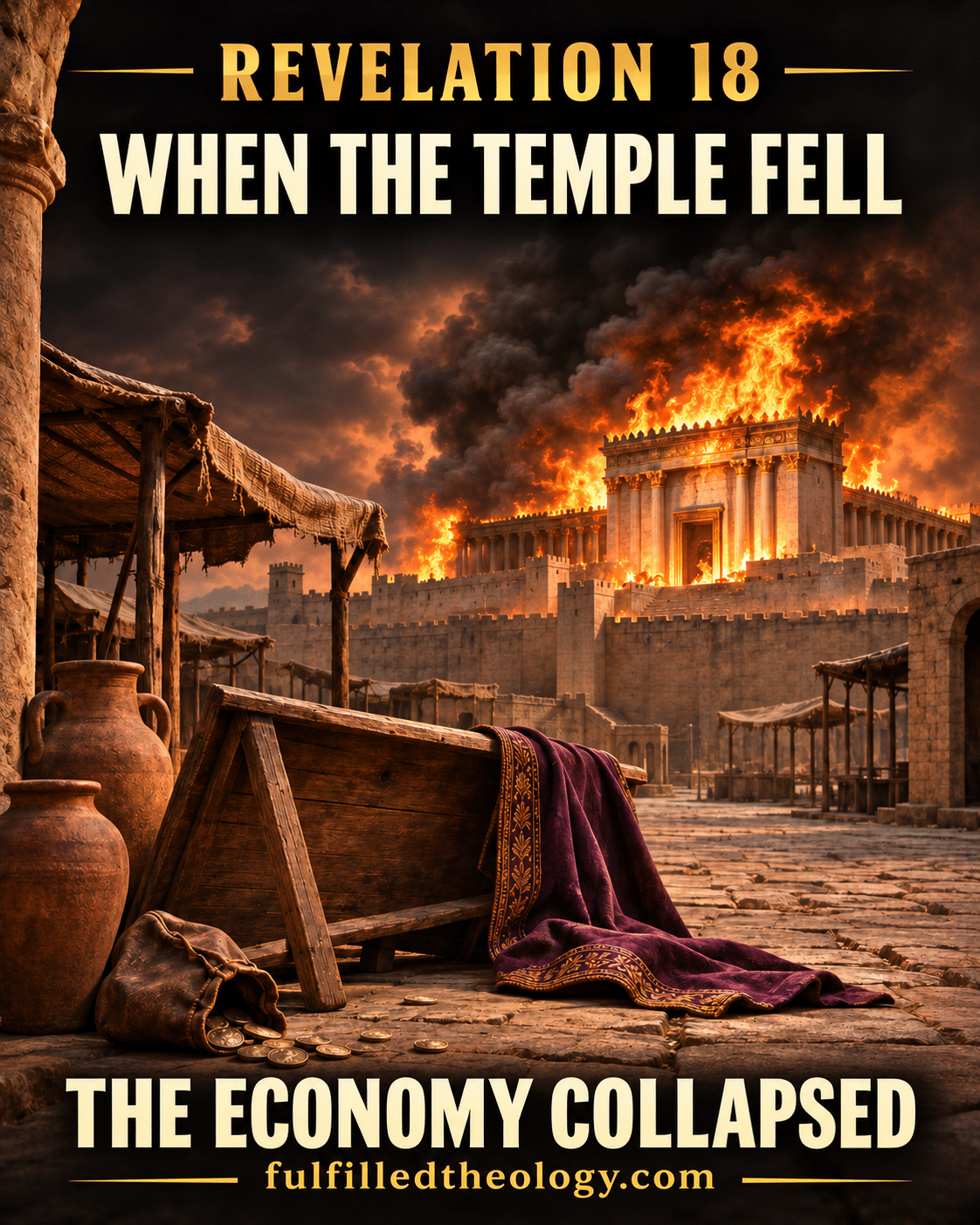
THE ECONOMY COLLAPSED
Revelation 18: When the Market Went Silent
For years, Revelation 18 has been preached as a warning about a coming worldwide financial collapse. People read about wealthy merchants, burning riches, and ships standing afar off, then reach for today’s headlines to explain yesterday’s prophecy. But before we put Wall Street into John’s vision, we need to walk through the streets of the world his readers knew. What city was facing judgment? Why were its merchants so wealthy? And what happened to their livelihood when the system supporting it came crashing down?
From the perspective of fulfilled theology, this chapter describes the judgment of first-century Jerusalem under the symbolic name Babylon. Its destruction in AD 70 brought devastating consequences for the temple-centered economy. Behind the sacrifices, religious ceremonies, and crowded festivals stood a network of contributions, purchases, labor, and trade. When the temple fell, the consequences reached well beyond the men who ministered at its altar.
To understand the merchants’ tears, we must first understand the city that made them rich.
And in her was found the blood of prophets, and of saints, and of all that were slain upon the earth.
Revelation 18:24
John closes the chapter by identifying the city’s bloodguilt. That sends us directly to Jesus’ indictment of Jerusalem. The connection is especially striking when we remember whom Jesus held accountable and when He said judgment would come.
Verily I say unto you, All these things shall come upon this generation.
Matthew 23:36
O Jerusalem, Jerusalem, thou that killest the prophets, and stonest them which are sent unto thee, how often would I have gathered thy children together, even as a hen gathereth her chickens under her wings, and ye would not!
Matthew 23:37
Jesus had just spoken of the righteous blood shed upon the earth, from Abel to Zacharias. He then placed the reckoning upon that generation and named Jerusalem. Revelation’s charge against Babylon belongs beside those words. We are reading a covenant indictment against the city that rejected God’s messengers and persecuted His people.
Revelation 11:8 provides another important connection by describing the great city as spiritually Sodom and Egypt, where the Lord was crucified. Jerusalem could carry the names of former enemies because of what it had become. Isaiah had already called the once-faithful city a harlot in Isaiah 1:21. The reading developed here understands Babylon in that same prophetic manner. Although many interpreters identify Revelation’s Babylon with Rome, the bloodguilt and covenant imagery form the heart of the case for Jerusalem. In our reading of Revelation 17, the woman is Jerusalem and the beast carrying her is Rome.
That distinction matters. We should establish the city’s identity from the larger biblical argument before using its economic life to illuminate the vision.
Three times in a year shall all thy males appear before the LORD thy God in the place which he shall choose; in the feast of unleavened bread, and in the feast of weeks, and in the feast of tabernacles: and they shall not appear before the LORD empty:
Deuteronomy 16:16
Every man shall give as he is able, according to the blessing of the LORD thy God which he hath given thee.
Deuteronomy 16:17
The law brought worshippers to the place God chose, and they were to bring gifts. By the first century, Jerusalem’s temple drew people from distant communities. Acts 2:5–11 gives us a glimpse of that far-reaching Jewish world, naming visitors associated with Mesopotamia, Asia Minor, Egypt, Libya, Rome, Crete, and Arabia. These were people connected by worship across considerable distances.
Think about the practical side of those journeys. People needed food and lodging. Sacrificial animals had to be raised, transported, and purchased. Offerings required agricultural produce. Goods needed handling, and travelers needed services. The temple stood at the center of religious life, while surrounding businesses benefited from the people it drew. The altar and the marketplace were connected through the ordinary demands of worship and travel.
Exodus 30:13–16 supplies the earlier half-shekel sanctuary contribution background. Matthew 17:24–27 reflects the temple payment in Jesus’ day. We should distinguish the original census instruction in Exodus from its later annual administration, but the economic point is straightforward: the sanctuary received money as well as sacrifices.
Josephus explains the temple’s accumulated wealth by describing contributions from Jewish communities and worshippers across the inhabited world, including Asia and Europe. His discussion appears in Antiquities of the Jews 14.7.2. Elsewhere, in Antiquities 18.9.1, he describes contributions gathered in Mesopotamia and conveyed to Jerusalem under substantial protection. This was an established flow of religious funds across great distances.[1][2]
Jerusalem’s economy did not stop at the city gates.
And found in the temple those that sold oxen and sheep and doves, and the changers of money sitting:
John 2:14
And said unto them that sold doves, Take these things hence; make not my Father’s house an house of merchandise.
John 2:16
Jesus confronted commerce within the temple precincts. Oxen, sheep, doves, and money changers were part of the scene. We do not have to imagine a commercial connection and then force it into the text. John places it right before our eyes. The provision of animals and the exchange of money served practical purposes, but Jesus condemned what had been made of His Father’s house.
Matthew 21:13 records His charge that it had become a den of thieves. That expression reaches back to Jeremiah 7:11, where people treated the temple as a refuge while continuing in wrongdoing. The problem went deeper than a busy marketplace. Religious privilege had become a covering for corruption, and confidence in the building had taken the place of hearing the God whose name it bore.
Now listen to the merchants in Revelation.
And the merchants of the earth shall weep and mourn over her; for no man buyeth their merchandise any more:
Revelation 18:11
John tells us why they mourn. Their customers are gone. The market that enriched them has collapsed. These tears reveal their attachment to the prosperity they enjoyed through the city. Their lament contains no confession of her bloodshed or repentance over her corruption. They are grieving what they have lost.
The merchandise of gold, and silver, and precious stones, and of pearls, and fine linen, and purple, and silk, and scarlet, and all thyine wood, and all manner vessels of ivory, and all manner vessels of most precious wood, and of brass, and iron, and marble,
Revelation 18:12
And cinnamon, and odours, and ointments, and frankincense, and wine, and oil, and fine flour, and wheat, and beasts, and sheep, and horses, and chariots, and slaves, and souls of men.
Revelation 18:13
The list paints a picture of wealth, luxury, provisions, transport, and human exploitation. Some items have obvious connections with worship. Flour, oil, wine, incense, and animals appear throughout the sacrificial instructions. Precious materials and costly fabrics also belonged to the world of sacred furnishings and wealthy households. The economic setting includes both religious demand and the broader consumption of a prosperous city.
We do not need to turn every item into a hidden reference to a temple furnishing. John’s list is wider than that. Nor should we spiritualize away the disturbing reference to slaves and human lives. People themselves appear among the commodities of this corrupt order. Its wealth came with a human cost.
The merchants of these things, which were made rich by her, shall stand afar off for the fear of her torment, weeping and wailing,
Revelation 18:15
The words made rich by her explain their relationship to the city. They benefited from her prosperity, but when judgment arrived, they kept their distance. Their wealth could not buy her deliverance. The system that had filled their pockets could no longer protect itself.
The ships and sailors sometimes become an objection to identifying the city with Jerusalem. Jerusalem was inland. That is true, and we should acknowledge it plainly. But we must also ask where John obtained the language of his vision.
And shall cause their voice to be heard against thee, and shall cry bitterly, and shall cast up dust upon their heads, they shall wallow themselves in the ashes:
Ezekiel 27:30
Ezekiel 27 is a lament over Tyre, a commercial city whose downfall brings grief to those who traded with her. The chapter contains merchants, costly goods, mariners, ships, bitter cries, and dust cast upon the head. Those same features appear together in Revelation 18. John draws upon an established prophetic picture of commercial ruin.
And they cast dust on their heads, and cried, weeping and wailing, saying, Alas, alas that great city, wherein were made rich all that had ships in the sea by reason of her costliness! for in one hour is she made desolate.
Revelation 18:19
The resemblance is too substantial to ignore. John depicts Babylon’s downfall through the language of Tyre’s downfall. That does not turn Babylon into literal Tyre, any more than calling Jerusalem Egypt requires moving it beside the Nile. The imagery gives the reader a familiar biblical picture of a wealthy city brought low.
An inland city can also participate in trade carried partly by sea. Merchandise can travel by ship, reach a port, and continue inland. Still, Revelation gives us a prophetic vision, not a shipping manifest. We should not pretend to have located every vessel or identified every merchant. The Old Testament parallel explains the imagery more securely than an invented eyewitness scene of sailors watching Jerusalem burn from their decks.
Likewise, in one hour emphasizes the suddenness and decisiveness of the ruin. The war and siege did not last sixty minutes. An order that appeared firmly established was brought to a catastrophic end. Long-standing prosperity offered no guarantee against the judgment Jesus had announced.
History helps us appreciate the scale of the disruption. Josephus reports that Roman soldiers obtained such quantities of plunder that gold in Syria sold for half its former value. That is his report in The Jewish War 6.6.1, not a modern economic calculation. It illustrates the enormous transfer of wealth accompanying the conquest.[3]
He also records that, after the war, Jews were required to pay an annual two-drachma levy to the Capitol in Rome, corresponding to what they had formerly contributed to Jerusalem’s temple. The payment continued under a new Roman demand, while the sanctuary it had once supported lay destroyed. The destination and meaning of the money had changed.[4]
These reports do not independently prove the identity of Revelation’s Babylon. They do show why Jerusalem’s destruction must be understood as an economic catastrophe as well as a military and religious one. The temple’s sacrificial service ended. Its established stream of contributions ceased to support it. The businesses sustained by temple worship and pilgrimage lost the foundation of their trade. This was far more than damage to a building.
And I heard another voice from heaven, saying, Come out of her, my people, that ye be not partakers of her sins, and that ye receive not of her plagues.
Revelation 18:4
This verse is often preached from pulpits today to urge believers to separate themselves from the world and avoid associating with it. However, let us remain faithful to sound hermeneutics by interpreting this passage within its original historical and covenantal context.
God’s people were called to separate themselves from the condemned city and its sins. This warning recalls the earlier calls to leave Babylon, including Jeremiah 51:6 and 45. Within the Jerusalem reading, it also stands alongside Jesus’ practical warning to His disciples.
And when ye shall see Jerusalem compassed with armies, then know that the desolation thereof is nigh.
Luke 21:20
Then let them which are in Judaea flee to the mountains; and let them which are in the midst of it depart out; and let not them that are in the countries enter thereinto.
Luke 21:21
For these be the days of vengeance, that all things which are written may be fulfilled.
Luke 21:22
Jesus named the city, described the warning, and instructed His hearers to leave. Their security would be found in believing His word. The place they had once approached for worship would become a place from which they must flee. That is the weight of the covenant transition. Loyalty to God required listening to His Son even when His warning overturned their inherited expectations.
The chapter then brings its finality into view through a powerful acted symbol.
And a mighty angel took up a stone like a great millstone, and cast it into the sea, saying, Thus with violence shall that great city Babylon be thrown down, and shall be found no more at all.
Revelation 18:21
Jeremiah supplies the clearest background.
And it shall be, when thou hast made an end of reading this book, that thou shalt bind a stone to it, and cast it into the midst of Euphrates:
Jeremiah 51:63
And thou shalt say, Thus shall Babylon sink, and shall not rise from the evil that I will bring upon her: and they shall be weary. Thus far are the words of Jeremiah.
Jeremiah 51:64
The stone sinks as a visible announcement of Babylon’s overthrow. Revelation takes up that image of irreversible judgment. Jesus’ millstone warnings in Matthew 18:6 and Luke 17:2 provide a related picture of terrible judgment, but Jeremiah gives us the direct Babylon-and-sinking-stone connection. We should let the strongest parallel carry the explanation.
In the covenantal reading, the finality concerns Jerusalem in its condemned role as the center of the old temple order. It does not require the claim that no city could ever occupy that geographical location again. What fell was the city and sanctuary as that generation had known them, with their priestly service, sacrifices, and surrounding religious economy.
Moreover I will take from them the voice of mirth, and the voice of gladness, the voice of the bridegroom, and the voice of the bride, the sound of the millstones, and the light of the candle.
Jeremiah 25:10
Jeremiah had already described judgment on Judah through the silencing of everyday life. Revelation 18:22–23 uses this same kind of language: music stops, craftsmen cease their work, the mill falls silent, the lamp goes dark, and wedding voices are heard no more. These are the sounds and sights of a living community. Their disappearance portrays comprehensive desolation.
You can almost hear the silence. The streets that once bustled with buyers and sellers no longer hum with business. The grinding that prepared the day’s food has stopped. The celebrations have ended. John makes the reader feel the loss of an entire way of life.
Yet the merchants’ lament is not the last word.
Rejoice over her, thou heaven, and ye holy apostles and prophets; for God hath avenged you on her.
Revelation 18:20
The same event produces two very different responses. Those enriched by the city mourn their loss. Heaven rejoices that the persecuted have received justice. This is vindication of the victims whose blood the city had shed.
The thread runs through the Scriptures. Deuteronomy 32:43 speaks of God avenging the blood of His servants. Jesus places Jerusalem’s reckoning within that generation in Matthew 23. In Revelation 6:9–11, the slain saints ask how long and are told to rest for a little season. Revelation 18 announces vengeance on the city, and Revelation 19:2 declares that the blood of God’s servants has been avenged. The cry beneath the altar has received its answer.
This is why we must keep the economic collapse inside the covenant story. Revelation 18 presents wealth bound up with corruption, persecution, and false security. The merchants’ loss is part of a larger judgment upon an order that resisted Christ and shed the blood of His witnesses.
For here have we no continuing city, but we seek one to come.
Hebrews 13:14
Those words belonged to believers living through the transition. The earthly city could not provide their lasting security. Hebrews directed them toward what God was establishing in Christ, and Revelation moves from Babylon’s fall to the holy city, New Jerusalem. In fulfilled theology, that movement brings us to the established New Covenant people of God, whose life rests in Christ.
The temple’s destruction did not purchase redemption. Jesus had already accomplished that through His once-for-all sacrifice. AD 70 brought the devastating historical end of the sacrificial establishment that continued to operate after His finished work. Hebrews 10:18 makes the sufficiency of that work plain: where sins are remitted, there is no more offering for sin.
Revelation 18 calls us to hear what the Spirit was saying to those first-century churches. The city that seemed secure was judged. The merchants who trusted its prosperity lost their market. The saints whose cries appeared unanswered were vindicated. The old temple economy could fall, but the life Christ had given His people did not depend upon its survival.
The market went silent. The promise of God stood firm.
Historical sources:
[1] Josephus, Antiquities of the Jews 14.7.2: Link
[2] Josephus, Antiquities of the Jews 18.312–313: Link
[3] Josephus, The Jewish War 6.6.1: Link
[4] Josephus, The Jewish War 7.218: Link
Scripture quotations are from the King James Version. Main text: Link

