
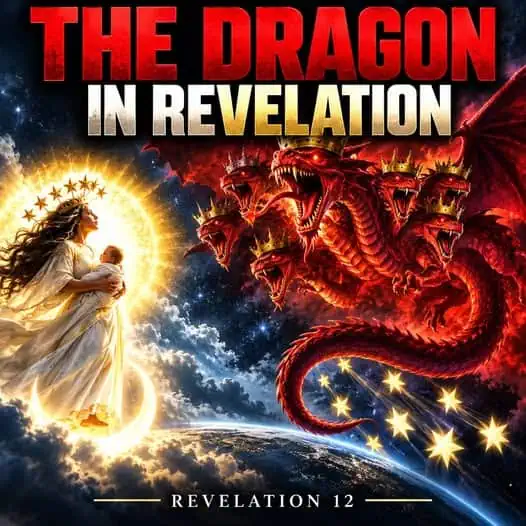
When most Christians read Revelation 12, they immediately picture a supernatural fallen angel named Satan fighting another supernatural angel named Michael somewhere beyond the visible universe. But what if we have allowed later assumptions to determine the meaning of John’s symbols before examining how those symbols function within the biblical story?
John writes:
And there was war in heaven: Michael and his angels fought against the dragon; and the dragon fought and his angels, Revelation 12:7
And prevailed not; neither was their place found any more in heaven. Revelation 12:8
And the great dragon was cast out, that old serpent, called the Devil, and Satan, which deceiveth the whole world: he was cast out into the earth, and his angels were cast out with him. Revelation 12:9
We should remember that Revelation is an apocalyptic book filled with signs and symbols. Earlier in the chapter, we are shown a woman clothed with the sun, the moon under her feet, and twelve stars upon her head. A great red dragon appears with seven heads, ten horns, and seven crowns. His tail sweeps a third of the stars from heaven. None of this requires us to suddenly abandon symbolic language when we arrive at verse 9.
So what does the dragon actually DO?
He stands against the birth of Christ. He seeks to destroy the child. He accuses the brethren. He persecutes the woman. Finally, he goes to make war against those who keep the commandments of God and have the testimony of Jesus.
That sounds remarkably similar to the adversarial powers we encounter throughout the New Testament.
When Jesus came into the world, He immediately encountered earthly powers determined to destroy Him. Herod sought the young child’s life. Later, the chief priests, scribes, elders, rulers, and Roman authorities joined in opposition to Him. Peter described this very thing:
The kings of the earth stood up, and the rulers were gathered together against the Lord, and against his Christ. Acts 4:26
For of a truth against thy holy child Jesus, whom thou hast anointed, both Herod, and Pontius Pilate, with the Gentiles, and the people of Israel, were gathered together, Acts 4:27
Notice the language: kings and rulers opposing Christ.
This is important because Revelation itself connects satanic language with opposition coming through identifiable human adversaries. Jesus told the church at Smyrna:
I know thy works, and tribulation, and poverty, but thou art rich, and I know the blasphemy of them which say they are Jews, and are not, but are the synagogue of Satan. Revelation 2:9
Again:
Behold, I will make them of the synagogue of Satan, which say they are Jews, and are not, but do lie Revelation 3:9
Whatever conclusions we ultimately reach about the dragon, we cannot ignore that Revelation itself associates the language of Satan with a hostile religious opposition persecuting the followers of Christ.
Jesus used similar language when confronting His opponents:
Ye are of your father the devil, and the lusts of your father ye will do. He was a murderer from the beginning John 8:44
This does not require us to imagine that these men ceased being human beings and became supernatural creatures. They were functioning as adversaries, accusers, persecutors, and murderers.
And that is exactly what the word Satan means: adversary. The word devil, from diabolos, carries the idea of a slanderer or accuser.
Now look again at Revelation 12. John actually tells us what happens when the dragon is cast down:
For the accuser of our brethren is cast down, which accused them before our God day and night. Revelation 12:10
There it is.
The accuser.
And who continually accused Jesus and His followers throughout the Gospel accounts and Acts? The New Testament repeatedly places Christ and the early church before councils, rulers, chief priests, elders, scribes, and authorities who accused them, condemned them, imprisoned them, and sometimes killed them.
Jesus even warned His disciples beforehand:
But take heed to yourselves: for they shall deliver you up to councils; and in the synagogues ye shall be beaten Mark 13:9
That persecution belongs directly to Jesus’ first-century Olivet Discourse.
Then Revelation 12 says:
And the dragon was wroth with the woman, and went to make war with the remnant of her seed, which keep the commandments of God, and have the testimony of Jesus Christ. Revelation 12:17
That is not merely an abstract cosmic battle. John is describing a war against the people who possessed the testimony of Jesus Christ.
The book of Acts shows us that conflict repeatedly. The apostles preach Christ; religious authorities oppose them. Stephen testifies of Christ; the council condemns him. Paul preaches Christ; opponents follow him from city to city, stirring up persecution.
This also helps us understand Paul’s language concerning principalities and powers. Biblical language about rulers, powers, thrones, dominions, princes, kings, authorities, heavens, and high places should not automatically be assumed to describe invisible supernatural creatures. Scripture frequently uses exalted language for earthly governmental and covenantal authorities.
Revelation 12 may therefore be presenting in apocalyptic imagery the great covenantal conflict surrounding Christ and the birth of the New Covenant people of God. The dragon represents the adversarial power standing behind the persecution, accusation, and resistance against Christ and His people, expressed historically through rulers and authorities, including the hostile Jewish hierarchy and the political powers with which it cooperated.
And Revelation gives us an important time statement:
Therefore rejoice, ye heavens, and ye that dwell in them. Woe to the inhabiters of the earth and of the sea! For the devil is come down unto you, having great wrath, because he knoweth that he hath but a short time. Revelation 12:12
A short time.
That deserves our attention.
John was not telling his first-century readers about an adversary who would rage thousands of years into their future. The dragon knew his time was short.
The same generation that witnessed Christ opposed, the apostles accused, the church persecuted, and believers brought before councils and synagogues was approaching the climactic covenant judgment Jesus had already announced.
Perhaps we have spent too much time asking what kind of creature the dragon was and not enough time asking what the dragon represented and who was actually doing the accusing, persecuting, and killing in the world of the New Testament.
When Revelation is allowed to speak within its own first-century covenantal setting, the dragon, serpent, devil, Satan, rulers, authorities, accusers, and persecutors begin to belong to one unfolding story:
The powers of the old order fighting desperately against Christ and His Kingdom.