
Table of Contents
ONE HARVEST, TWO GROUPS: THE JUDGMENT ON ISRAEL
One of the most misunderstood parables Jesus taught is the parable of the wheat and the tares. For generations, Christians have been taught that the wheat represents true believers within the church, while the tares represent false Christians growing alongside them. According to this interpretation, both groups will remain together until the end of the physical world, when Christ will return, separate them, and cast the wicked into everlasting torment.
But is that what Jesus was teaching? Was He describing the condition of churches thousands of years into the future, or was He warning His own generation about a judgment that was rapidly approaching?
To understand this parable, we must examine the audience Jesus was addressing, the age in which they were living, and the meaning of the harvest. We must also recognize that Jesus repeatedly used different illustrations to describe the same separation between two groups: believing Israel and unbelieving Israel.
The wheat and the tares, the wheat and the chaff, the good trees and the bad trees, the good fruit and the bad fruit, and the sheep and the goats all point toward the same covenantal division. These illustrations were not disconnected warnings about events thousands of years into the future. They concerned the approaching judgment upon the Old Covenant nation and the preservation of those who believed in Christ.
The harvest was not the end of the physical world. It was the conclusion of the Old Covenant age, culminating in the destruction of Jerusalem and its temple in AD 70.
THE WHEAT AND THE TARES GROWING TOGETHER
Another parable put he forth unto them, saying, The kingdom of heaven is likened unto a man which sowed good seed in his field:
Matthew 13:24
But while men slept, his enemy came and sowed tares among the wheat, and went his way.
Matthew 13:25
But when the blade was sprung up, and brought forth fruit, then appeared the tares also.
Matthew 13:26
So the servants of the householder came and said unto him, Sir, didst not thou sow good seed in thy field? from whence then hath it tares?
Matthew 13:27
He said unto them, An enemy hath done this. The servants said unto him, Wilt thou then that we go and gather them up?
Matthew 13:28
But he said, Nay; lest while ye gather up the tares, ye root up also the wheat with them.
Matthew 13:29
Let both grow together until the harvest: and in the time of harvest I will say to the reapers, Gather ye together first the tares, and bind them in bundles to burn them: but gather the wheat into my barn.
Matthew 13:30
Notice that Jesus did not command His servants to separate the wheat from the tares immediately. Both were permitted to grow together until the appointed harvest.
This is important because wheat and tares can appear remarkably similar during their early stages of growth. The difference becomes more evident as they mature and bear fruit.
Jesus was describing two groups living alongside one another during the same covenantal period. The believing remnant of Israel and those who rejected Christ shared the same land, history, temple system, and religious environment. Yet their response to the Messiah revealed a fundamental separation.
The harvest would expose that difference.
It is also important to notice that the wheat was not destroyed alongside the tares. The wheat was gathered into the barn, or garner, representing preservation and security. The tares were gathered for burning, representing judgment.
One group would inherit the kingdom. The other would experience the consequences of rejecting its King.
JESUS EXPLAINS THE PARABLE
He answered and said unto them, He that soweth the good seed is the Son of man;
Matthew 13:37
The field is the world; the good seed are the children of the kingdom; but the tares are the children of the wicked one;
Matthew 13:38
The enemy that sowed them is the devil; the harvest is the end of the world; and the reapers are the angels.
Matthew 13:39
Jesus identifies the characters and the timing of the parable.
The sower is the Son of Man. The good seed represents the children of the kingdom. The tares represent the children of the wicked one. The harvest occurs at the end of the age, and the reapers are the angels.
The word translated world in the expression end of the world is the Greek word aiōn, Strong’s G165. It refers to an age or period of time. Jesus was not describing the destruction of the planet but the consummation of an age.
Interestingly, when Jesus says the field is the world in Matthew 13:38, He uses a different Greek word, kosmos. The field is the world, but the harvest marks the conclusion of an age.
Which age was approaching its conclusion?
Jesus and His disciples were living during the final generation of the Old Covenant order. The Mosaic system, centered upon Jerusalem and its temple, was approaching its appointed end. The New Covenant had been established through Christ, and the transition between the covenants would reach its consummation with the destruction of the temple in AD 70.
Within this first-century setting, the wheat represents believing Israel, those who received Christ as the promised Messiah. The tares represent unbelieving Israel, particularly those who rejected Christ and followed the religious authorities who opposed Him.
The distinction was not between Jews and Gentiles. It was between those who believed and those who refused to believe.
WHO WAS HIS ENEMY THAT SOWED THE TARES?
This is one of the most important details in the entire parable, and it is often overlooked.
But while men slept, his enemy came and sowed tares among the wheat, and went his way.
Matthew 13:25
Notice the wording. Jesus did not merely say that an enemy came and sowed tares. He said His enemy.
Whose enemy?
Jesus answers that question Himself.
He answered and said unto them, He that soweth the good seed is the Son of man;
Matthew 13:37
The sower is Jesus Christ. Therefore, the enemy who came and sowed the tares was the enemy of Christ.
Now consider the historical setting of Jesus’ ministry. Who were His principal adversaries? Who continually opposed His teaching, accused Him, attempted to discredit Him, and influenced the people to reject Him?
The religious leadership of unbelieving Israel.
Jesus identifies the enemy as the devil in Matthew 13:39. The Greek word translated devil is diabolos, meaning slanderer or accuser.
Rather than automatically imagining a supernatural fallen angel moving invisibly through the fields, we should examine the adversarial activity taking place during Jesus’ ministry.
The scribes, Pharisees, and chief priests repeatedly functioned as His accusers and opponents. They resisted His kingdom, distorted the truth, and persuaded others to reject Him.
Consider what Jesus said directly to them.
But woe unto you, scribes and Pharisees, hypocrites! for ye shut up the kingdom of heaven against men: for ye neither go in yourselves, neither suffer ye them that are entering to go in.
Matthew 23:13
Notice the accusation. These religious leaders were not entering the kingdom, and they were actively hindering others from entering.
They were not simply rejecting Christ themselves. They were influencing others to reject Him as well.
This is remarkably consistent with the adversarial activity described in the parable. The enemy sowed among the good seed, producing opposition to the kingdom.
And consider what happened when Jesus stood before Pilate.
But the chief priests and elders persuaded the multitude that they should ask Barabbas, and destroy Jesus.
Matthew 27:20
The religious leadership influenced the people to reject Christ. Their opposition did not remain confined to themselves. They persuaded others to participate in that rejection.
Within this covenantal interpretation, the devil sowing the tares represents the adversarial work of the unbelieving religious leadership, whose accusations, deception, and opposition influenced the people against their Messiah.
The enemy was His enemy. The opposition was directed against Christ and His kingdom.
The conflict was taking place within Israel itself.
THE HARVEST AND THE REAPERS
As therefore the tares are gathered and burned in the fire; so shall it be in the end of this world.
Matthew 13:40
The Son of man shall send forth his angels, and they shall gather out of his kingdom all things that offend, and them which do iniquity;
Matthew 13:41
And shall cast them into a furnace of fire: there shall be wailing and gnashing of teeth.
Matthew 13:42
Then shall the righteous shine forth as the sun in the kingdom of their Father. Who hath ears to hear, let him hear.
Matthew 13:43
The Greek word translated angels is angeloi, meaning messengers. Depending upon the context, it can refer to heavenly messengers or human messengers.
Here, the angels function as agents of the Son of Man, carrying out His appointed separation and judgment. The passage does not require us to imagine a future worldwide agricultural harvest involving literal angels gathering human beings from the earth.
The important point is that Christ Himself directs the harvest. The separation belongs to His authority, and it occurs at the consummation of the age.
Notice also that the righteous shine forth in the kingdom of their Father. This language echoes Daniel’s prophecy concerning the time of the end, the deliverance of God’s people, and the resurrection.
And they that be wise shall shine as the brightness of the firmament; and they that turn many to righteousness as the stars for ever and ever.
Daniel 12:3
Daniel 12 places this shining of the righteous in the context of Israel’s final covenantal crisis. Jesus draws upon that same imagery when describing the harvest.
The kingdom was not waiting to begin thousands of years later. The believing remnant would enter the fullness of the New Covenant kingdom as the Old Covenant age reached its conclusion.
THE WHEAT AND THE CHAFF: THE SAME JUDGMENT
Before Jesus taught the parable of the wheat and the tares, John the Baptist had already announced the approaching separation.
And now also the axe is laid unto the root of the trees: therefore every tree which bringeth not forth good fruit is hewn down, and cast into the fire.
Matthew 3:10
Whose fan is in his hand, and he will throughly purge his floor, and gather his wheat into the garner; but he will burn up the chaff with unquenchable fire.
Matthew 3:12
Notice John’s language.
The axe was already laid to the root of the trees. The winnowing fan was already in Christ’s hand.
John was not announcing a judgment that would remain unfulfilled for thousands of years. He was warning Israel about an approaching separation.
The wheat would be gathered into the garner, a place of preservation. The chaff would be consumed by unquenchable fire.
This is the same covenantal separation illustrated by the wheat and the tares.
The wheat represents those who believed in Christ. The chaff represents those who rejected Him. The fire represents the judgment that would come upon Jerusalem and the Old Covenant order.
The word unquenchable does not require a fire that burns people consciously forever. It describes a fire that cannot be extinguished or prevented from accomplishing its purpose.
Scripture often uses fire to describe God’s judgment upon nations and cities. Jerusalem’s destruction in AD 70 provides the historical fulfillment of the judgment John was announcing.
GOOD TREES, BAD TREES, AND THE FRUIT OF THE KINGDOM
Jesus also used the imagery of trees and fruit to describe the same distinction.
Even so every good tree bringeth forth good fruit; but a corrupt tree bringeth forth evil fruit.
Matthew 7:17
A good tree cannot bring forth evil fruit, neither can a corrupt tree bring forth good fruit.
Matthew 7:18
Every tree that bringeth not forth good fruit is hewn down, and cast into the fire.
Matthew 7:19
How often have these passages been used to frighten Christians into believing that if they fail to produce enough good works, they will be cast into eternal torment?
But consider the covenantal setting.
John had already announced that the axe was laid to the root of the trees. Jesus continued using the same imagery as He confronted the unbelief and hypocrisy of Israel’s religious leadership.
The fruit revealed the character of the tree. Those who received Christ demonstrated the fruit of faith, while those who rejected Him demonstrated the fruit of unbelief.
Jesus made this distinction especially clear in His parable of the wicked husbandmen.
Therefore say I unto you, The kingdom of God shall be taken from you, and given to a nation bringing forth the fruits thereof.
Matthew 21:43
And when the chief priests and Pharisees had heard his parables, they perceived that he spake of them.
Matthew 21:45
There is no confusion about the immediate audience. The chief priests and Pharisees understood that Jesus was speaking against them.
The kingdom would be taken from the unfaithful leadership and given to a people bringing forth its fruit.
This was not a warning that Christians throughout history would lose their salvation every time they failed to produce sufficient good works. It was a declaration of covenantal judgment upon those who rejected the Messiah.
The good trees and bad trees, like the wheat and tares, reveal the distinction between believing and unbelieving Israel.
THE SHEEP AND THE GOATS: ANOTHER PICTURE OF SEPARATION
Jesus continued using the imagery of two groups when He described the separation of the sheep and goats.
When the Son of man shall come in his glory, and all the holy angels with him, then shall he sit upon the throne of his glory:
Matthew 25:31
And before him shall be gathered all nations: and he shall separate them one from another, as a shepherd divideth his sheep from the goats:
Matthew 25:32
And he shall set the sheep on his right hand, but the goats on the left.
Matthew 25:33
The imagery is familiar. Once again, two groups are separated at the coming of the Son of Man.
The sheep represent those who belong to the King. The goats represent those who stand under judgment.
Within the first-century covenantal interpretation, this separation concerns the same fundamental distinction between believing and unbelieving Israel.
Jesus had already identified the immediate focus of His earthly ministry.
But he answered and said, I am not sent but unto the lost sheep of the house of Israel.
Matthew 15:24
His ministry began among the covenant people of Israel, and His warnings repeatedly concerned their response to Him.
The sheep and goats imagery belongs to the same larger discussion of judgment and kingdom consummation. The distinction is not between people who have performed enough charitable works to earn heaven and those who have failed to do so. Their treatment of Christ’s brethren reveals their relationship to the King.
Different illustrations, but the same central covenantal separation.
One group received the Messiah. The other rejected Him.
EVERLASTING PUNISHMENT AND THE FIRE OF JUDGMENT
And these shall go away into everlasting punishment: but the righteous into life eternal.
Matthew 25:46
This verse is frequently used to teach that unbelievers will suffer conscious torment without end.
But we must examine the language within its context rather than assume that every reference to fire describes the traditional doctrine of hell.
Note: The Greek word translated everlasting and eternal is aiōnios, Strong’s G166, derived from aiōn, Strong’s G165.
The word can describe what is eternal, but its meaning and force must be understood within the context in which it appears.
In Matthew 25, the context is judgment at the coming of the Son of Man. Within the fulfilled-eschatology understanding, that judgment belongs to the conclusion of the Old Covenant age.
The punishment was real, severe, and irreversible. Jerusalem was destroyed, the temple was burned, and the Old Covenant sacrificial system came to its historical end.
The fire represents the certainty and severity of divine judgment. It does not automatically establish the doctrine of everlasting conscious torment.
At the same time, the parallel between everlasting punishment and eternal life deserves careful attention. The argument for a first-century fulfillment rests upon the covenantal setting of the judgment, not simply upon claiming that aiōnios always means temporary.
We must allow the historical audience, prophetic context, and scriptural use of judgment imagery to guide our interpretation.
JESUS IDENTIFIED THE GENERATION THAT WOULD EXPERIENCE THE JUDGMENT
Now consider one of the clearest passages identifying the audience and timing of this covenantal judgment.
Ye serpents, ye generation of vipers, how can ye escape the damnation of hell?
Matthew 23:33
Wherefore, behold, I send unto you prophets, and wise men, and scribes: and some of them ye shall kill and crucify; and some of them shall ye scourge in your synagogues, and persecute them from city to city:
Matthew 23:34
That upon you may come all the righteous blood shed upon the earth, from the blood of righteous Abel unto the blood of Zacharias son of Barachias, whom ye slew between the temple and the altar.
Matthew 23:35
Verily I say unto you, All these things shall come upon this generation.
Matthew 23:36
Jesus was speaking directly to the scribes and Pharisees, the very religious leadership who opposed His ministry and influenced the people against Him.
He warned that judgment would come upon their generation.
Immediately afterward, Jesus identified Jerusalem as the city that killed the prophets and rejected those sent to her.
Jesus actually cared and wept over Jerusalem.
O Jerusalem, Jerusalem, thou that killest the prophets, and stonest them which are sent unto thee, how often would I have gathered thy children together, even as a hen gathereth her chickens under her wings, and ye would not!
Matthew 23:37
Behold, your house is left unto you desolate.
Matthew 23:38
The connection is unmistakable within this interpretation. Jesus confronted the unbelieving leadership, pronounced judgment upon that generation, and announced the desolation of Jerusalem.
The destruction of Jerusalem in AD 70 was not an unrelated historical tragedy. It was the covenantal judgment Jesus had warned His contemporaries about.
This is the historical setting in which we understand the harvest.
THE PROPHET MOSES FORETOLD THE SAME SEPARATION
Peter continued announcing this covenantal distinction after the resurrection of Christ.
And it shall come to pass, that every soul, which will not hear that prophet, shall be destroyed from among the people.
Acts 3:23
Peter was addressing Israel and identifying Jesus as the prophet Moses had promised.
The warning was directed toward those who refused to hear Christ. They would be destroyed from among the people.
Once again, we see the same two groups.
Those who received Christ belonged to the faithful remnant. Those who rejected Him faced the judgment associated with the close of the Old Covenant age.
This was the separation pictured by the wheat and tares, the wheat and chaff, the good and bad trees, and the sheep and goats.
The illustrations differ, but the covenantal message remains consistent.
THE WHEAT WAS GATHERED INTO SAFETY
Let both grow together until the harvest: and in the time of harvest I will say to the reapers, Gather ye together first the tares, and bind them in bundles to burn them: but gather the wheat into my barn.
Matthew 13:30
Notice the destination of the wheat.
The wheat was not burned. It was gathered into the barn, the place of security and preservation.
This beautifully illustrates the preservation of the believing remnant during the judgment that came upon unbelieving Israel.
Another scripture to consider:
The name of the LORD is a strong tower: the righteous runneth into it, and is safe.
Proverbs 18:10
Jesus had promised deliverance to those who heeded His warnings. The believers who recognized the approaching destruction were instructed to flee rather than remain within Jerusalem.
Then let them which be in Judaea flee into the mountains:
Matthew 24:16
The early Christian historian Eusebius records a tradition that the Jerusalem church departed to Pella before the destruction of the city. Although the historical details of that flight are debated, the tradition illustrates the early Christian understanding that believers were preserved from Jerusalem’s catastrophe.
The greater meaning of the garner, however, is covenantal. The faithful were gathered into the security of Christ and the completed New Covenant kingdom.
The Old Covenant order was passing away, but those who belonged to Christ were not left without a kingdom.
They had received one that could not be shaken.
Wherefore we receiving a kingdom which cannot be moved, let us have grace, whereby we may serve God acceptably with reverence and godly fear:
Hebrews 12:28
The destruction of the temple did not destroy the kingdom of God. It marked the removal of the old covenantal order and the consummation of the kingdom established through Christ.
The wheat was preserved. The chaff was burned. The harvest was completed.
DOES THE CHURCH TODAY STILL CONTAIN WHEAT AND TARES?
This brings us back to the common interpretation of the parable.
Many Christians have been taught that every congregation contains wheat and tares, true believers and false believers, and that no one should attempt to distinguish between them because Jesus will perform that separation at the end of the physical world.
But that interpretation overlooks the appointed timing of the harvest.
Jesus did not say the harvest would continue throughout the entire New Covenant age. He identified the harvest with the end of the age.
The field was not identified as a local church congregation. The parable concerned the children of the kingdom and the children of the wicked one growing together until the appointed consummation.
Certainly, churches today can contain sincere believers, hypocrites, and people who do not truly believe. Scripture gives us principles for discernment, correction, and spiritual maturity.
But that does not mean the prophetic harvest of Matthew 13 remains unfinished.
We must distinguish between a spiritual lesson that can be applied today and a prophetic event that had a specific historical fulfillment.
The harvest Jesus described belonged to the conclusion of the Old Covenant age. It was not an ongoing process of separating church members for thousands of years.
The New Covenant church is not waiting for the destruction of Jerusalem. That judgment has already occurred.
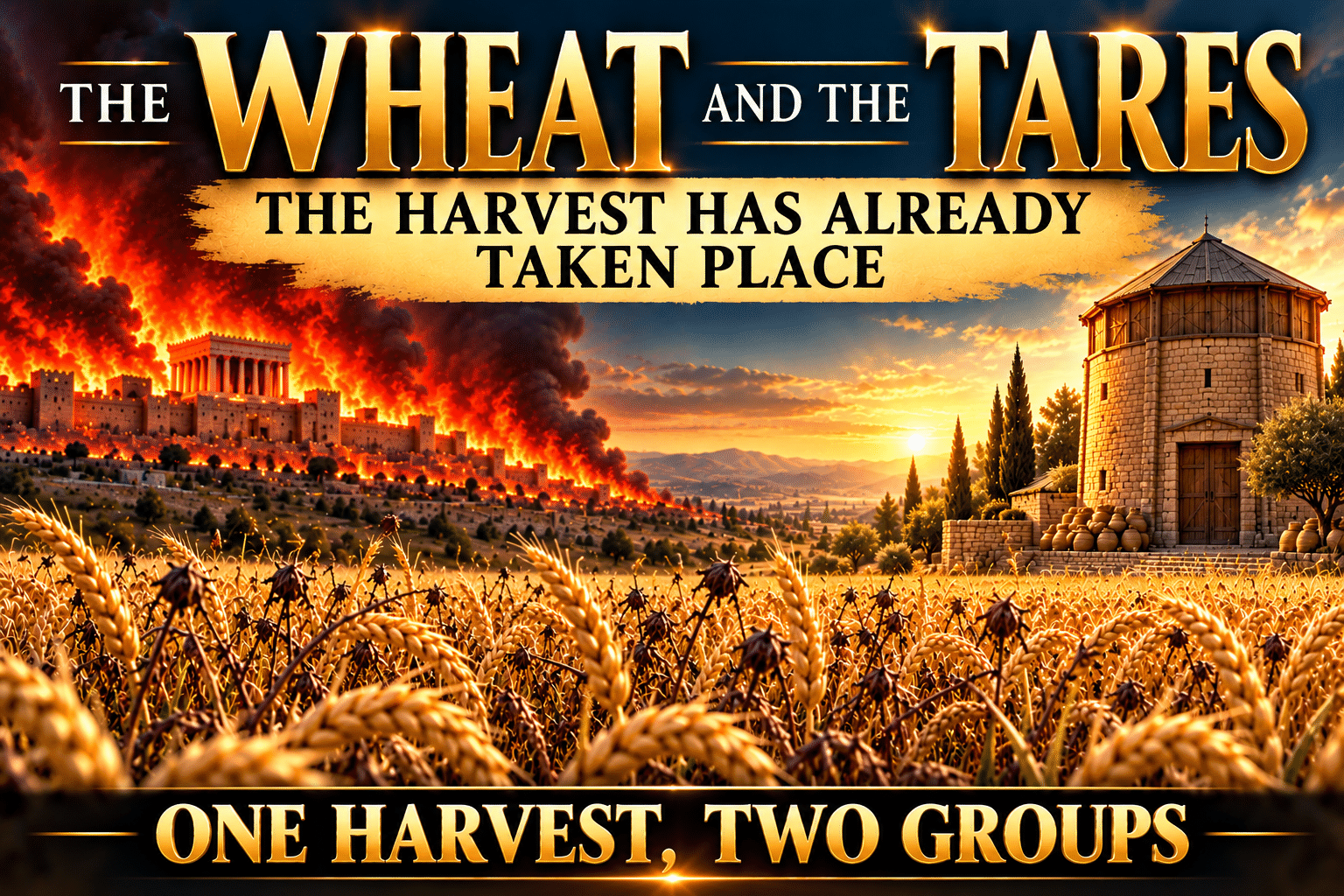
ONE HARVEST, TWO GROUPS
Throughout His ministry, Jesus repeatedly used agricultural and pastoral imagery to illustrate the separation taking place within Israel.
The wheat and the tares grew together until the harvest.
The wheat was gathered into the garner while the chaff was burned.
The good trees bore fruit while the corrupt trees were cut down.
The sheep were separated from the goats.
The faithful received the kingdom while those who rejected Christ experienced covenantal judgment.
These were not unrelated prophecies pointing toward multiple judgments scattered across thousands of years. Within the fulfilled-eschatology interpretation, they describe different aspects of the same great covenantal transition.
Jesus came to the lost sheep of the house of Israel. He called them to repentance, proclaimed the kingdom, and warned that judgment was approaching.
Some believed. Others rejected Him.
The religious leadership opposed His ministry, hindered others from entering the kingdom, and ultimately persuaded the people to demand His crucifixion.
Yet the kingdom continued to advance.
The believing remnant received the promises of God through Christ, while the unbelieving covenantal order faced its appointed end.
In AD 70, Jerusalem was destroyed and the temple was burned. The sacrificial system ceased, and the Old Covenant world centered upon the temple came to its historical conclusion.
The harvest had reached its fulfillment.
The wheat was gathered into the security of the kingdom, and the tares were subjected to the judgment Jesus had announced.
The wheat and the tares were not a prophecy about Christians waiting thousands of years for a future separation at the end of the physical universe. They were a warning about the conclusion of an age and the judgment that would come upon unbelieving Israel.
ONE HARVEST.
TWO GROUPS.
ONE COVENANTAL JUDGMENT.
THE HARVEST HAS ALREADY TAKEN PLACE.

