
Table of Contents
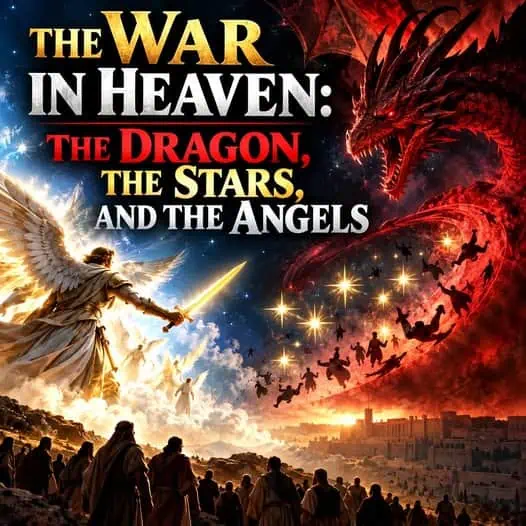
When most people read Revelation 12, they immediately picture a prehistoric battle in outer space between God’s angels and a supernatural fallen angel named Satan.
But is that what John was actually seeing?
Before we interpret the symbols, we need to remember something extremely important:
JOHN WAS IN A VISION
And the imagery John saw did not originate in Revelation. It came straight out of the Old Testament prophets. Revelation 12:3-4
3 And there appeared another wonder in heaven; and behold a great red dragon, having seven heads and ten horns, and seven crowns upon his heads.
4 And his tail drew the third part of the stars of heaven, and did cast them to the earth.
Who are these stars?
Scripture had already taught Israel how to understand this kind of imagery.
In Joseph’s dream, the family of Israel was represented by the sun, moon, and stars. Genesis 37:9
And he dreamed yet another dream, and told it his brethren, and said, Behold, I have dreamed a dream more; and, behold, the sun and the moon and the eleven stars made obeisance to me.
The eleven stars represented Joseph’s brothers, the tribes of Israel.
And the connection between stars and the children of Israel goes back even further to Abraham.
When God promised Abraham that He would multiply his seed, He used two powerful pictures: the stars of heaven and the sand of the seashore.
And he brought him forth abroad, and said, Look now toward heaven, and tell the stars, if thou be able to number them: and he said unto him, So shall thy seed be. Genesis 15:5
Then God reaffirmed the promise:
That in blessing I will bless thee, and in multiplying I will multiply thy seed as the stars of the heaven, and as the sand which is upon the sea shore. Genesis 22:17
That imagery became part of Israel’s covenant identity. Abraham’s seed was pictured as the stars of heaven. Then in Genesis 37, Jacob’s sons themselves appear as stars. So when we arrive at the prophets and eventually Revelation and see stars involved in covenantal judgment, we should not immediately assume John is talking about literal celestial bodies or fallen supernatural beings. Scripture has already given us a strong covenantal precedent for identifying stars with Abraham’s descendants, the children of Israel.
So when a Jewish reader familiar with the prophets read about stars being cast down, he already possessed a biblical vocabulary for understanding the imagery.
Daniel uses remarkably similar language.
And it waxed great, even to the host of heaven; and it cast down some of the host and of the stars to the ground, and stamped upon them. Daniel 8:10
Nobody needs to imagine literal stars falling out of outer space or even another picture outside of Israel’s covenantal identity.
This is prophetic language describing the overthrow and humiliation of covenantal rulers and people.
That brings us directly to Revelation 12.
The dragon draws a third of the stars and casts them to the earth. John is seeing the covenant conflict involving Israel portrayed through the prophetic imagery Israel already knew.
But then something else happens.
And there was war in heaven: Michael and his angels fought against the dragon; and the dragon fought and his angels. Revelation 12:7
Again, our minds immediately run to invisible supernatural creatures fighting somewhere beyond the clouds.
But before we make that assumption, we should ask:
WHERE HAVE WE SEEN MICHAEL BEFORE?
Daniel.
And Daniel was also seeing visions.
But the prince of the kingdom of Persia withstood me one and twenty days: but, lo, Michael, one of the chief princes, came to help me. Daniel 10:13
Then Daniel says:
And there is none that holdeth with me in these things, but Michael your prince. Daniel 10:21
Notice that carefully.
MICHAEL YOUR PRINCE
Michael is specifically connected with Daniel’s people.
Then Daniel 12 brings Michael back into the picture.
And at that time shall Michael stand up, the great prince which standeth for the children of thy people. Daniel 12:1
Whose people?
Daniel’s people.
Israel.
And what immediately follows?
A time of unprecedented trouble.
Now listen to Jesus:
For then shall be great tribulation, such as was not since the beginning of the world to this time, no, nor ever shall be. Matthew 24:21
Daniel’s prophecy and Jesus’ Olivet Discourse are dealing with the same covenantal crisis surrounding Daniel’s people.
If we go back to Daniel, God told him to shut up the words and seal the book.
But thou, O Daniel, shut up the words, and seal the book, even to the time of the end: many shall run to and fro, and knowledge shall be increased. Daniel 12:4
Then John picks up that same prophetic imagery in Revelation.
And he saith unto me, Seal not the sayings of the prophecy of this book: for the time is at hand. Revelation 22:10
Remember, what Daniel saw a beginning in a vision, John saw the ending in a vision.
That is why I believe we make a serious mistake when we automatically remove Revelation 12 from its Jewish prophetic framework and turn it into a cosmic history lesson about something that supposedly happened before Adam and Eve existed.
John was seeing the culmination of the covenant conflict.
And what about the word angels?
The Greek word angelos simply means messenger. Context determines whether the messenger is heavenly or human.
Scripture plainly uses the word for human messengers.
John the Baptist had messengers.
Jesus sent messengers.
The spies entering Jericho are called messengers.
And Revelation itself opens with messages being delivered to the angels or messengers of the seven churches.
So we cannot simply see the English word “angel” and automatically assume an invisible spirit being every time in the scriptures. .
Now look at the dragon.
Revelation identifies him as:
And the great dragon was cast out, that old serpent, called the Devil, and Satan, which deceiveth the whole world. Revelation 12:9
The word Satan means adversary. Keep this in mind.
The word devil carries the idea of an accuser or slanderer. We can’t forget this either when reading covenantal imagery.
And who consistently filled the role of adversary and accuser against Christ and His people throughout the New Testament?
Jesus repeatedly confronted the unbelieving opposing religious leadership of Jerusalem.
They accused Him. They plotted against Him. They delivered Him to Rome. They persecuted His apostles. They opposed the preaching of the Gospel.
And after the cross, that same adversarial power turned its fury against the woman and her seed.
That fits Revelation 12 remarkably well.
And when the dragon saw that he was cast unto the earth, he persecuted the woman which brought forth the man child. Revelation 12:13
The dragon persecutes. The dragon accuses. The dragon opposes the people of God. The dragon attempts to destroy the seed.
This is the same covenantal conflict running throughout the New Testament and reaching its climax in the judgment of the Old Covenant world.
And notice something else.
Look what this verse says:
For the accuser of our brethren is cast down, which accused them before our God day and night. Revelation 12:10
This is courtroom language. Accusation. Condemnation. And Judgment.
The Old Covenant administration that condemned men through the Law was passing away, while the New Covenant kingdom established in Christ was coming fully into its inheritance.
That is why the very next declaration is:
Now is come salvation, and strength, and the kingdom of our God, and the power of his Christ. Revelation 12:10
This is not primarily a traditional story about angels fighting demons in outer space, or even the story of Satan falling to earth as some rebellious heavenly choir director.
It is a prophetic picture of KINGDOM TRANSITION.
Old Covenant versus New Covenant. Accusation versus justification. Persecution versus victory. The dragon versus the people of God.
And the battlefield is described as heaven because prophetic Scripture repeatedly uses heavenly language for rulers, authorities, covenantal powers, and governmental order.
That is why Daniel could see princes fighting.
That is why stars could be cast down. That is why the sun and moon could be darkened. And that is why John could see war in heaven. Daniel saw it in a vision. John saw it in a vision. Both were using prophetic imagery. Both were dealing with Daniel’s people.
And both were pointing toward the covenantal conflict that reached its climax in the first century.
Before we turn Revelation into a story about invisible beings fighting somewhere in another dimension, perhaps we should first allow the Bible to interpret its own symbols.
THE DRAGON.
THE STARS.
MICHAEL.
THE MESSENGERS.
THE WAR IN HEAVEN.
The imagery was not new.
John was finishing a story the prophets had already begun.