Table of Contents
A COVENANT JUDGMENT THE BLIND DID NOT SEE COMING
Introduction
For generations, Christians have been taught that the thief in the night refers to a future, unexpected return of Jesus Christ to destroy the physical world. The expression has often been used to suggest that no one could know anything about the timing of His coming and that the entire world would be caught by surprise. But this kept believers in continual fear hoping and praying they would be ready. Many grew up with this distress and anxiety.
But is that what Jesus and His apostles were teaching?
When we examine the Scriptures within their historical and covenantal setting, a very different picture begins to emerge.
The thief in the night was not a warning about the end of the physical universe. It was a warning concerning the approaching Day of the Lord, when God would bring judgment upon the Old Covenant world that had rejected His Son.
The Jewish religious leadership continued in its confidence concerning the temple, the law, and its covenantal standing. Meanwhile, Jesus and His apostles were warning that judgment was approaching.
The distinction was not simply between people who knew something and people who did not. It was between those who believed the warning and those who remained in darkness.
The Day of the Lord would come unexpectedly upon one group, while another had been instructed to watch.
And perhaps the most important question is this: If the Day of the Lord was supposed to surprise everyone, why did Paul tell the Thessalonians that it would not overtake them as a thief?
The Times and the Seasons
But of the times and the seasons, brethren, ye have no need that I write unto you.
1 Thessalonians 5:1
Notice Paul’s opening statement. He tells the Thessalonian believers that he had no need to write to them concerning the times and seasons.
Why?
Because they had already received instruction concerning the approaching Day of the Lord.
Paul was not introducing an entirely new subject. He was reminding them of something they had already been taught.
The expression times and seasons is important because Scripture associates these terms with God’s authority over historical events, kingdoms, and appointed periods.
And he changeth the times and the seasons: he removeth kings, and setteth up kings: he giveth wisdom unto the wise, and knowledge to them that know understanding:
Daniel 2:21
Daniel understood that the rise and fall of kingdoms did not occur independently of God’s sovereign purpose. God established their appointed times and determined when their authority would end.
This provides an important background for understanding the approaching end of the Mosaic Covenant age.
The kingdom established through Christ was not waiting for a distant generation to begin. It had already arrived, and the Old Covenant order was approaching its final removal.
But there is another interesting connection concerning times and seasons.
When they therefore were come together, they asked of him, saying, Lord, wilt thou at this time restore again the kingdom to Israel?
Acts 1:6
And he said unto them, It is not for you to know the times or the seasons, which the Father hath put in his own power.
Acts 1:7
Consider the disciples’ question.
They were asking Jesus about the restoration of the kingdom to Israel. Their understanding was still influenced by the expectations associated with the Old Covenant nation.
This conversation occurred before Pentecost, before the outpouring of the Holy Spirit upon the disciples.
Although Christ had already accomplished His redemptive work through His death and resurrection, the Old Covenant order had not yet reached its historical consummation.
The disciples were living during the transition between the two covenantal ages.
Jesus did not provide them with a date. Instead, He directed their attention to the coming power of the Holy Spirit and the witness they would bear.
Now return to Paul’s statement.
The Thessalonian believers had received apostolic instruction concerning the times and seasons. They were not left in ignorance concerning the approaching judgment.
The difference was not that God had changed His appointed purpose. The difference was the understanding being revealed through Christ and His apostles.
Not knowing the exact day and hour did not mean they were unable to recognize the approaching season.
That distinction becomes essential as we continue.
The Day of the Lord Would Come as a Thief
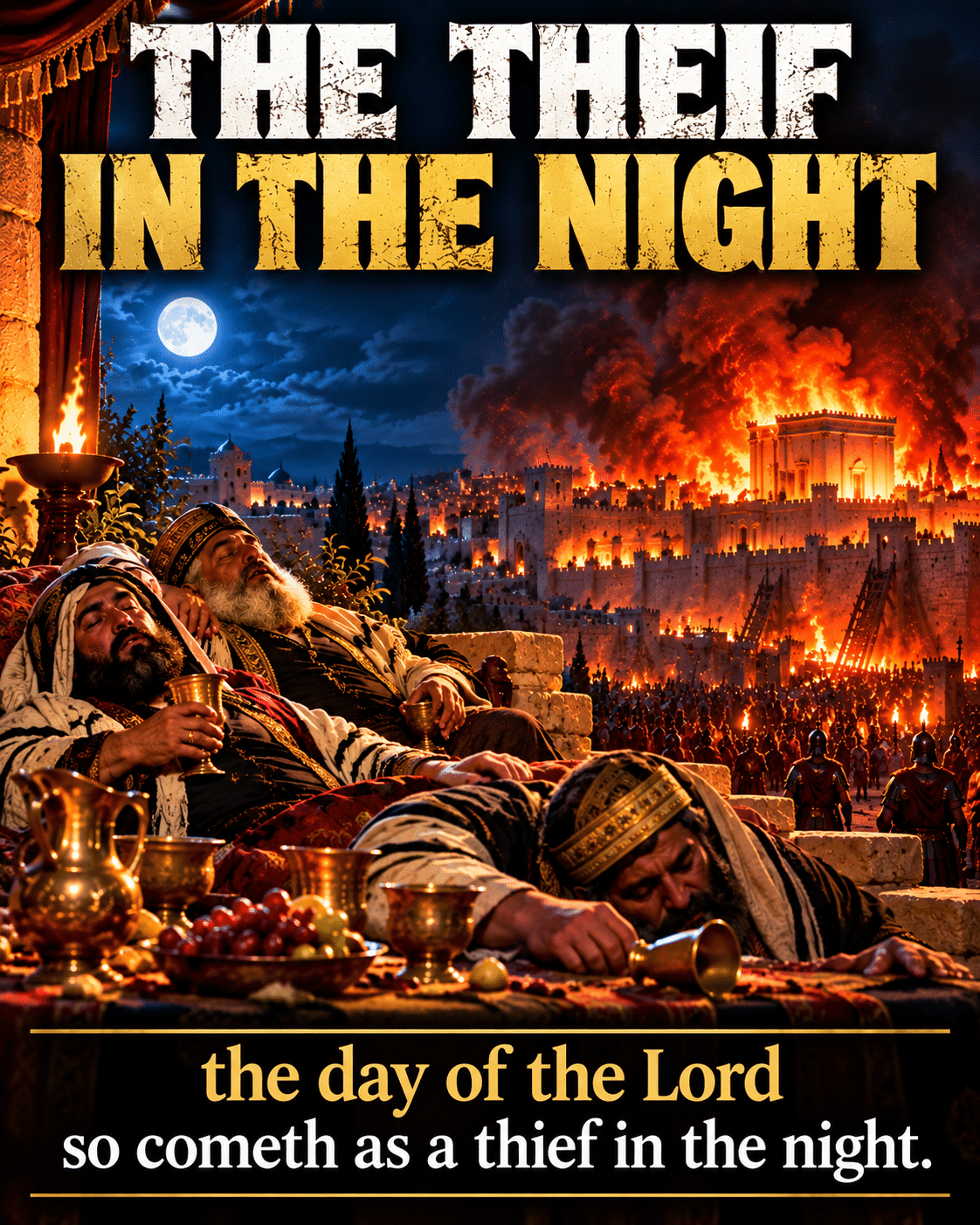
For yourselves know perfectly that the day of the Lord so cometh as a thief in the night.
1 Thessalonians 5:2
Paul tells them that they already knew perfectly how the Day of the Lord would come.
Notice that he did not say Jesus would appear as a literal thief.
The thief was a figure of speech describing the unexpected arrival of judgment upon those who were unprepared.
A thief comes when the occupants are unaware, sleeping, or failing to watch.
But the question is, who was sleeping?
Who was in darkness?
Who was drunken?
And who had been warned?
Paul answers those questions in the verses that follow.
Peace and Safety Before Sudden Destruction
For when they shall say, Peace and safety; then sudden destruction cometh upon them, as travail upon a woman with child; and they shall not escape.
1 Thessalonians 5:3
There is something very important about Paul’s choice of words.
He says THEY shall say peace and safety.
Then sudden destruction comes upon THEM.
And THEY shall not escape.
Paul is identifying a particular group facing judgment.
The expression peace and safety also deserves historical consideration.
During the first century, the Roman Empire promoted the Pax Romana, or Roman Peace. Rome presented its imperial rule as a source of peace, order, stability, and security.
The Thessalonian believers lived within that Roman world and would have been familiar with its claims of imperial security.
It is possible that Paul’s expression peace and safety reflects that political atmosphere.
But there is a striking historical irony.
The very empire that promoted peace and security would become the instrument through which Jerusalem and its temple were destroyed.
The Jewish religious establishment also possessed its own confidence. The temple remained standing, the priesthood continued functioning, and the religious system appeared firmly established.
Yet Jesus had already pronounced judgment upon that generation.
What appeared secure was approaching destruction.
Paul compares the sudden arrival of judgment to the travail of a woman with child.
The point is not merely that the event would be unexpected. Labor pains also describe an approaching event that, once begun, cannot simply be stopped.
The destruction would come upon those who had refused the warning.
And Paul says they would not escape.
This was not a declaration that every individual throughout the Roman Empire would experience identical destruction. It was a warning concerning the approaching judgment and the people who would be overtaken by it.
But Ye, Brethren, Are Not in Darkness
But ye, brethren, are not in darkness, that that day should overtake you as a thief.
1 Thessalonians 5:4
Here is the verse that changes the entire understanding of the thief in the night.
Paul does not say that the Day of the Lord would overtake everybody unexpectedly.
He says the opposite concerning the brethren.
They were not in darkness, and therefore that day should not overtake them as a thief.
Why have we so often been taught that nobody could recognize the approaching Day of the Lord when Paul specifically told his original audience that they were not in darkness?
The answer is found in the contrast between the two covenantal worlds.
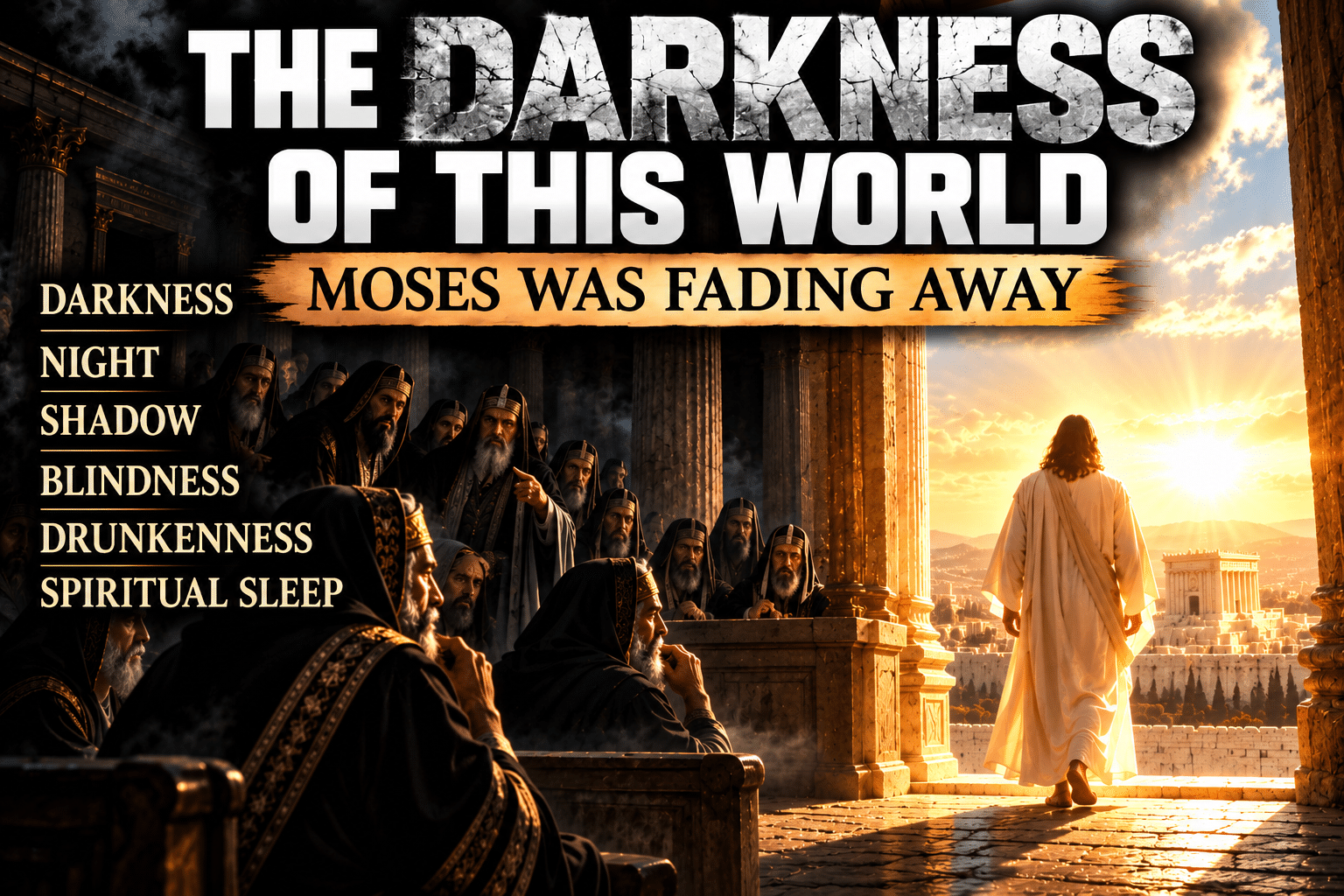
Throughout our studies, we have examined the symbolic relationship between darkness and the Old Covenant order, particularly where that order was characterized by unbelief and rejection of Christ.
John introduced Jesus as the light that entered the darkness.
In him was life; and the life was the light of men.
John 1:4
And the light shineth in darkness; and the darkness comprehended it not.
John 1:5
Christ was the light revealing the life and reality of the New Covenant.
Those who rejected Him continued in the darkness associated with the passing order.
The religious leadership possessed the Scriptures, maintained the temple, and administered the law. Yet many rejected the very Messiah to whom those Scriptures pointed.
They could recognize the traditions of their fathers, but they refused the revelation of Christ.
The believers, however, had received the light.
They were not waiting for the New Covenant to become a reality at some distant point in history. They had already entered into life through Christ.
And that is why Paul could tell them that the approaching Day of the Lord should not overtake them as a thief.
Children of Light and Children of the Day
Ye are all the children of light, and the children of the day: we are not of the night, nor of darkness.
1 Thessalonians 5:5
Notice the present-tense language.
Paul says YE ARE the children of light.
He does not say they would become children of light after Jerusalem was destroyed.
Their identity in Christ was already established.
They belonged to the New Covenant while the Old Covenant world was approaching its final judgment.
This is an important distinction in understanding the forty-year transitional period between the ministry of Christ and the destruction of Jerusalem in AD 70.
The New Covenant had been inaugurated through the death and resurrection of Jesus Christ, and its blessings were already being experienced by believers.
Meanwhile, the old religious order continued functioning until its final removal.
Two covenantal realities were visible during that generation: the passing order centered upon the temple and the established kingdom of Christ.
The believers were children of the day because they belonged to Christ.
Those who rejected Him remained in darkness.
The approaching judgment would expose the difference.
They Were Sleeping in the Night
Therefore let us not sleep, as do others; but let us watch and be sober.
1 Thessalonians 5:6
For they that sleep sleep in the night; and they that be drunken are drunken in the night.
1 Thessalonians 5:7
Now we begin to understand the imagery of the thief in the night.
Paul describes two contrasting conditions.
One group was watching and sober.
The other was sleeping and drunken in the night.
He was not merely discussing literal sleep or physical intoxication. He was describing spiritual conditions.
Those who slept were unaware or unconcerned about the approaching judgment.
Those who were drunken lacked spiritual discernment and were completely and utterly intoxicated with the Mosaic structure.
They continued in their confidence while the warning of destruction was being proclaimed.
Consider the condition of the unbelieving religious establishment.
Jesus had warned of the approaching destruction of Jerusalem and its temple. His apostles continued proclaiming repentance and the kingdom of God.
Yet the religious authorities persecuted Christ’s followers and resisted the gospel.
They were spiritually asleep while judgment approached.
And this is what makes the thief imagery so significant.
The thief did not represent an unknown future event that nobody could understand. It represented judgment overtaking those who refused to watch.
Those who remained in darkness were unprepared.
Those who walked in the light had been warned.
Jesus Had Already Told Them to Watch
But of that day and that hour knoweth no man, no, not the angels which are in heaven, neither the Son, but the Father.
Mark 13:32
This passage is often used to argue that no one could know anything about the approaching judgment.
But we must read Jesus’ statement within the context of His entire warning concerning Jerusalem and the temple.
Jesus said no one knew the precise day or hour.
He did not say His disciples could not recognize the approaching judgment.
In fact, He immediately instructed them to watch.
For the Son of man is as a man taking a far journey, who left his house, and gave authority to his servants, and to every man his work, and commanded the porter to watch.
Mark 13:34
Watch ye therefore: for ye know not when the master of the house cometh, at even, or at midnight, or at the cockcrowing, or in the morning:
Mark 13:35
Lest coming suddenly he find you sleeping.
Mark 13:36
And what I say unto you I say unto all, Watch.
Mark 13:37
Do you see the connection?
Jesus warned His disciples not to be found sleeping when the master returned.
Paul warned the Thessalonians not to sleep as others did, but to watch and remain sober.
Jesus and Paul were using the same basic contrast.
Watching and sleeping.
Light and darkness.
Preparedness and unexpected judgment.
And both warnings belonged to the first-century expectation of the approaching Day of the Lord.
If Jesus intended His disciples to remain completely ignorant of the approaching judgment, why did He give them signs and command them to watch?
The answer is simple.
They could recognize the approaching season without knowing the exact day or hour.
And those who believed His warning would respond accordingly.
God’s Longsuffering During the Forty-Year Transition
The Lord is not slack concerning his promise, as some men count slackness; but is longsuffering to us-ward, not willing that any should perish, but that all should come to repentance.
2 Peter 3:9
Peter introduces another important dimension to the approaching Day of the Lord.
God’s longsuffering.
Some questioned why the promised judgment had not yet arrived.
But Peter explained that the apparent delay was not evidence that God had forgotten His promise.
It was an expression of divine mercy.
Within the forty-year transitional period, from the ministry of Christ to the destruction of Jerusalem, the gospel continued to be proclaimed.
The call to repentance was still going forth.
God was giving that generation an opportunity to turn from unbelief and receive life through Jesus Christ.
Consider the mercy revealed in that period.
The very nation whose leaders had rejected and crucified Christ continued receiving the proclamation of salvation through His apostles.
The temple still stood.
The priesthood still functioned.
The Mosaic system had not yet experienced its final historical removal.
Yet the message of the New Covenant was spreading throughout the Roman world.
Peter’s statement that God was not willing that any should perish reveals the purpose of His longsuffering.
Repentance meant turning to Christ and receiving the life of the New Covenant.
But there was also an approaching physical judgment.
The destruction of Jerusalem would bring tremendous suffering and loss of life.
Those who refused the warning faced the consequences of remaining within the condemned order.
The longsuffering of God was not an indefinite postponement of judgment.
It was mercy being extended before the appointed judgment arrived.
And then Peter says something remarkably similar to Paul.
But the day of the Lord will come as a thief in the night; in the which the heavens shall pass away with a great noise, and the elements shall melt with fervent heat, the earth also and the works that are therein shall be burned up.
2 Peter 3:10
Peter connects God’s longsuffering directly to the approaching Day of the Lord.
The same judgment that Paul described as coming like a thief is now described by Peter in the prophetic language of the passing heavens and earth.
This was covenantal judgment language concerning the removal of the Old Covenant order, not the annihilation of the physical universe.
The old heavens and earth represented the covenantal world that was passing away.
The temple, priesthood, sacrifices, and earthly religious system would no longer define the relationship between God and His people.
The New Covenant in Christ was the established reality.
The old order was approaching its final removal.
The Warning Was Given So They Could Escape
This brings us to an important historical distinction.
Jesus did not merely warn His disciples that Jerusalem would be destroyed. He instructed those in Judea to flee when the signs appeared.
But when ye shall see the abomination of desolation, spoken of by Daniel the prophet, standing where it ought not, (let him that readeth understand,)
Mark 13:14
And let him that is on the housetop not go down into the house, neither enter therein, to take any thing out of his house:
Mark 13:15
And let him that is in the field not turn back again for to take up his garment.
Mark 13:16
The warning was practical.
Those who recognized the approaching judgment were to act.
They were not instructed to remain in Jerusalem and wait for a supernatural rescue from the Roman armies.
They were instructed to flee.
Later Christian historical tradition records that believers from Jerusalem fled to Pella, a city east of the Jordan River, before Jerusalem’s destruction.
The exact historical circumstances of that flight remain debated, but the tradition reflects the early Christian understanding that Jesus’ warning concerned a real historical danger.
And this distinction is important.
The Thessalonian believers were not living in Judea. Paul’s instruction to them was not a geographical command to flee Jerusalem.
But they shared in the same covenantal hope, the same apostolic warnings, and the same expectation of the approaching Day of the Lord.
For believers living in Judea, watchfulness also carried the practical responsibility of escaping the coming destruction.
Those who believed the warning could flee.
Those who dismissed it risked being overtaken by the judgment.
Not Appointed to Wrath
But let us, who are of the day, be sober, putting on the breastplate of faith and love; and for an helmet, the hope of salvation.
1 Thessalonians 5:8
For God hath not appointed us to wrath, but to obtain salvation by our Lord Jesus Christ,
1 Thessalonians 5:9
Paul brings the contrast back to its central purpose.
The believers were not appointed to wrath.
They belonged to Christ.
They had received the light of the New Covenant, and their hope rested in Him.
Within the historical setting of the approaching judgment, this salvation included deliverance from the condemnation associated with the passing covenantal order.
And for believers in Judea who obeyed Jesus’ warning, it could also include physical preservation through flight from the approaching destruction.
But Paul’s assurance was greater than physical survival alone.
The promise of salvation was grounded in Jesus Christ.
And that brings us to his next statement.
Whether We Wake or Sleep, We Shall Live Together With Him
Who died for us, that, whether we wake or sleep, we should live together with him.
1 Thessalonians 5:10
This verse provides a beautiful conclusion to Paul’s warning.
Throughout the chapter, Paul has contrasted spiritual watchfulness with spiritual sleep.
But here, in the promise of living together with Christ, we also see a connection to the previous chapter, where Paul had addressed believers who had died.
His assurance was that death would not separate those who belonged to Christ from their promised life with Him.
Some believers would remain physically alive through the transitional period.
Others would die before its consummation.
But their hope did not depend upon remaining physically alive.
Christ had died for them.
And whether they lived or died, their promised life with Him remained secure.
This is why we must not reduce salvation merely to escaping the Roman armies.
Physical deliverance from Jerusalem’s destruction was important for those who lived in the region and obeyed Jesus’ warning.
But the greater promise was life in Christ.
The passing of the Old Covenant order would not destroy the people of God.
The kingdom of Christ would remain.
Those who belonged to Him possessed a hope that extended beyond physical death.
Conclusion: The Thief Came to Those Who Were Sleeping
The thief in the night was never intended to describe a mysterious event disconnected from the people to whom Jesus and His apostles were speaking.
It was a warning concerning an approaching judgment.
Jesus warned His disciples.
Paul warned the Thessalonians.
Peter explained God’s longsuffering before that judgment.
And throughout the forty-year transition, the gospel continued calling people to repentance.
The religious establishment continued in its confidence.
The temple remained standing.
The sacrifices continued.
The Roman world proclaimed peace and security.
But the appointed judgment was approaching.
Those who remained in darkness were spiritually asleep.
Those who rejected the warning were unprepared.
But the believers were children of light.
They had received the warning.
They were instructed to watch.
And Paul told them plainly that the approaching Day of the Lord should not overtake them as a thief.
The distinction was never that everyone would be caught by surprise.
The thief came upon those who were sleeping in darkness, not those who were watching in the light.
And in AD 70, the destruction of Jerusalem and its temple brought the Old Covenant age to its historical conclusion.
The old order passed away.
But the kingdom of Christ remained.
The New Covenant was not destroyed.
And those who belonged to Christ possessed the promise of life with Him.
The Day of the Lord was judgment upon the passing covenantal world, but it also marked the vindication of Christ and His kingdom.
The night belonged to the passing age. The light belonged to Christ. And His kingdom was here to stay.