
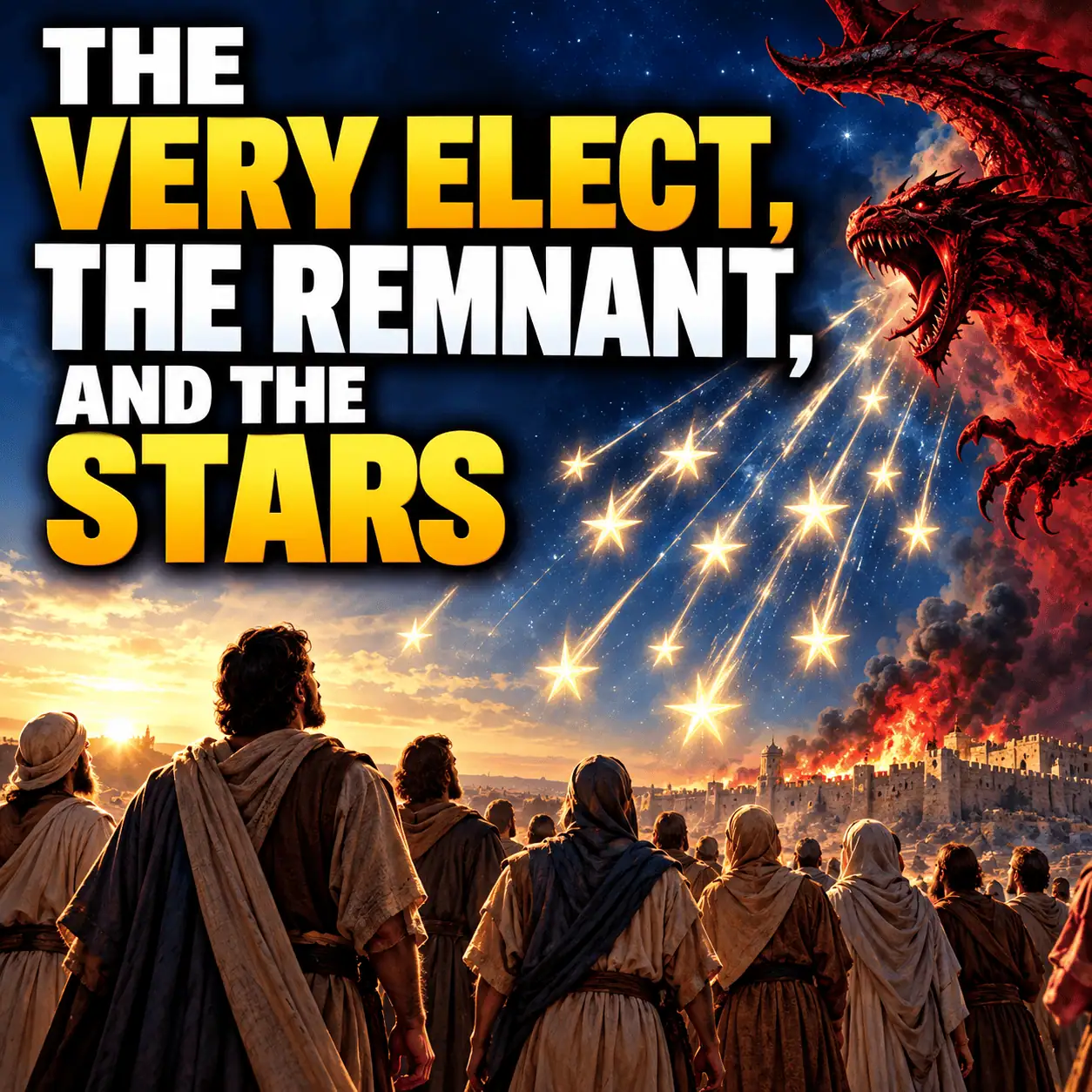
One of the most familiar interpretations of Revelation 12 is that the dragon drawing a third of the stars from heaven describes Satan taking one third of the angels with him in some prehistoric rebellion. But there is a serious problem with beginning there: Revelation never says these stars are fallen angels.
If we allow Scripture to establish its own prophetic language before interpreting John’s vision, another picture begins to emerge. The stars can be traced through Israel, the remnant, the elect, persecution, preservation, and the believing people of the first-century generation.
And his tail drew the third part of the stars of heaven, and did cast them to the earth. Revelation 12:4
Before deciding what those stars represent, we should ask a basic hermeneutical question: How had Scripture already used the imagery of stars?
And he dreamed yet another dream, and told it his brethren, and said, Behold, I have dreamed a dream more; and, behold, the sun and the moon and the eleven stars made obeisance to me. Genesis 37:9
Joseph did not need someone thousands of years later to explain the symbolism. His own family understood it.
And he told it to his father, and to his brethren: and his father rebuked him, and said unto him, What is this dream that thou hast dreamed? Shall I and thy mother and thy brethren indeed come to bow down ourselves to thee to the earth? Genesis 37:10
The stars represented the sons of Israel. That is an important biblical reference point when we come to Revelation 12 because John begins the chapter with the same kind of imagery.
And there appeared a great wonder in heaven; a woman clothed with the sun, and the moon under her feet, and upon her head a crown of twelve stars: Revelation 12:1
John’s imagery does not appear out of nowhere. Sun, moon, and stars had already been associated with the covenant family of Israel. So when stars appear only a few verses later, we should not immediately abandon that biblical background and jump to a story about angels rebelling before the creation of man.
But there is another Old Testament passage that becomes extremely interesting when Revelation speaks specifically of a third.
And it shall come to pass, that in all the land, saith the LORD, two parts therein shall be cut off and die; but the third shall be left therein. Zechariah 13:8
And I will bring the third part through the fire, and will refine them as silver is refined, and will try them as gold is tried: they shall call on my name, and I will hear them: I will say, It is my people: and they shall say, The LORD is my God. Zechariah 13:9
Notice what happens to the third. The third is not the apostate portion. The third is the preserved portion. They pass through the fire. They are refined. They call upon the name of the Lord. God calls them His people.
This is the language of a remnant. That becomes even more significant when we move to Daniel 12, because Daniel brings together several of the same ideas that later appear in Revelation 12: Michael, God’s people, an unparalleled time of trouble, deliverance, and stars.
And at that time shall Michael stand up, the great prince which standeth for the children of thy people: and there shall be a time of trouble, such as never was since there was a nation even to that same time: and at that time thy people shall be delivered, every one that shall be found written in the book.
Daniel 12:1
Michael is specifically associated with Daniel’s people during their time of trouble. Then only a few verses later Daniel uses the imagery of stars.
And they that be wise shall shine as the brightness of the firmament; and they that turn many to righteousness as the stars for ever and ever. Daniel 12:3
So before we ever arrive at Revelation 12, Scripture has already given us Israel represented through heavenly bodies, a preserved third, Michael standing for Daniel’s people during tribulation, deliverance during that tribulation, and the righteous described as stars.
Then Jesus takes us directly into the same prophetic setting.
For then shall be great tribulation, such as was not since the beginning of the world to this time, nor ever shall be. Matthew 24:21
Compare that with Daniel.
And there shall be a time of trouble, such as never was since there was a nation even to that same time. Daniel 12:1
Daniel’s unparalleled trouble and Jesus’ unparalleled tribulation are not disconnected events separated by thousands of years. Jesus was drawing directly from Daniel’s prophetic language and applying it to what was coming upon His generation.
And except those days should be shortened, there should be no flesh saved: but for the elect’s sake those days shall be shortened. Matthew 24:22
Now the elect enter the picture. They are not watching these events from thousands of years away. They are living in the middle of them. The days of that tribulation would be shortened for their sake.
For there shall arise false Christs, and false prophets, and shall shew great signs and wonders; insomuch that, if it were possible, they shall deceive the very elect.
Matthew 24:24
The elect were the target of deception and persecution during that first-century crisis. Jesus then speaks of their gathering.
And he shall send his angels with a great sound of a trumpet, and they shall gather together his elect from the four winds, from one end of heaven to the other. Matthew 24:31
And Jesus gives us the time statement that governs the prophecy.
Verily I say unto you, This generation shall not pass, till all these things be fulfilled. Matthew 24:34
These elect belonged to that first-century generation. They were the believing people of God passing through the final convulsions of the Old Covenant age.
Paul gives us another piece that is absolutely essential because he directly connects the remnant with election.
Even so then at this present time also there is a remnant according to the election of grace. Romans 11:5
Notice Paul’s words carefully: at this present time. Paul was not describing a remnant thousands of years in his future. There was a remnant in his own generation, and he called it a remnant according to the election of grace.
What then? Israel hath not obtained that which he seeketh for; but the election hath obtained it, and the rest were blinded. Romans 11:7
There were two groups within covenant Israel. There was unbelieving Israel, and there was the believing election. The elect were the faithful remnant who had embraced Israel’s Messiah.
Now return to Revelation 12.
And his tail drew the third part of the stars of heaven, and did cast them to the earth. Revelation 12:4
What if we stop importing the assumption that these are fallen angels and instead follow the prophetic trail Scripture has already established?
Genesis gives us Israel pictured as stars. Zechariah gives us a preserved third passing through the fire. Daniel gives us Michael standing for God’s people during unparalleled trouble and the faithful shining as stars.
Jesus gives us the elect being preserved through unparalleled tribulation in His generation. Paul explicitly calls the believing remnant the election of grace. And Revelation gives us a dragon persecuting the stars and ultimately pursuing the remnant.
That is an extraordinary line of continuity.
And there was war in heaven: Michael and his angels fought against the dragon; and the dragon fought and his angels, Revelation 12:7
Daniel had already introduced Michael as the prince who stood for Daniel’s people during their time of trouble. John is seeing another vision, just as Daniel was seeing visions. We should therefore be extremely careful about turning the visionary symbols into literal celestial creatures fighting a physical battle somewhere in outer space. Revelation is communicating covenant realities through prophetic imagery.
Then notice where Revelation 12 ends.
And the dragon was wroth with the woman, and went to make war with the remnant of her seed, which keep the commandments of God, and have the testimony of Jesus Christ. Revelation 12:17
There is our word again: REMNANT.
And who is this remnant? John tells us. They have the testimony of Jesus Christ.
Paul said there was, in his own present time, a remnant according to the election of grace. Jesus said the elect would endure the tribulation of His generation. Daniel saw God’s people delivered during the unparalleled trouble and described the righteous as stars. Zechariah saw the third passing through the fire and being preserved as God’s people. Revelation sees a third of the stars attacked by the dragon and concludes the chapter with the dragon making war against the remnant who possess the testimony of Jesus Christ.
These are not disconnected images. The third of the stars represents the believing remnant, the elect of that first-century generation, caught in the tremendous covenantal conflict surrounding the end of the Old Covenant age. The dragon casting them down does not mean they joined the dragon. They were his victims, not his followers. He was attempting to destroy the very people God had determined to preserve.
That distinction changes the entire picture.
The dragon did not sweep away one third of his own angels. He was waging war against God’s elect. He persecuted the stars. He pursued the woman. He made war against her remnant. The entire chapter presents the dragon as the enemy of the faithful, not their leader.
And this fits exactly what Jesus had warned His disciples would happen.
Then shall they deliver you up to be afflicted, and shall kill you: and ye shall be hated of all nations for my name’s sake. Matthew 24:9
The believing remnant would suffer. Some would be killed. Some would be scattered. They would be hated and persecuted. False prophets would attempt to deceive them. Yet God would preserve His elect through the covenantal judgment that was about to engulf that generation.
Revelation 12 is therefore not taking us backward into an undocumented rebellion of angels before human history. It is showing us, through prophetic imagery, the tremendous conflict surrounding the Messiah, Israel, the believing remnant, and the end of the age.
The stars were God’s people. The third was the preserved remnant. The remnant was the election of grace. The elect were living in Jesus’ generation.
And the dragon made war against them because they had the testimony of Jesus Christ.
When Revelation is allowed to speak the language of Genesis, Zechariah, Daniel, Jesus, and Paul, the pieces begin to fit together.
The third of the stars were not the dragon’s army. They were the people he was trying to destroy. They were the believing remnant. They were the elect.