
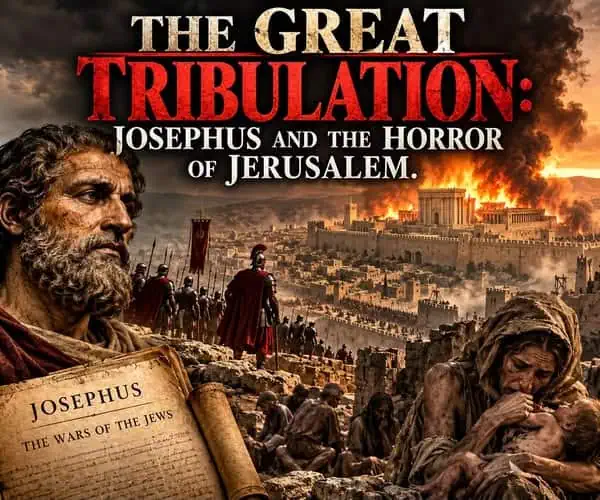
THE GREAT TRIBULATION: JOSEPHUS AND THE HORROR OF JERUSALEM
BIBLE PROPHECY AND RECORDED HISTORY
Sometimes history reads almost like a commentary on Bible prophecy.
Few examples are more striking than the destruction of Jerusalem in AD 70. Jesus did not merely predict that Jerusalem would someday experience trouble. He described armies surrounding the city, a fortification being built around it, its inhabitants being trapped on every side, terrible distress within its walls, and ultimately the destruction of the city and its Temple.
Approximately forty years later, history records these very events.
As Jesus approached Jerusalem, He looked upon the city and wept.
And when he was come near, he beheld the city, and wept over it, Luke 19:41
Jesus knew what was coming. He continued:
For the days shall come upon thee, that thine enemies shall cast a trench about thee, and compass thee round, and keep thee in on every side, Luke 19:43
Notice how specific His warning was.
Enemies would come against Jerusalem. They would surround her. They would construct a fortification around her. The inhabitants would be shut in on every side.
Then came the Jewish-Roman War and eventually the siege of Jerusalem in AD 70.
The Jewish historian Flavius Josephus personally witnessed the war and later recorded it in The Wars of the Jews. By the final siege of Jerusalem, Josephus was outside the city with the Roman forces and recorded many details concerning the siege.
Titus, son of the Roman emperor Vespasian and commander of the Roman forces, determined that Jerusalem must be completely sealed off. If escape could be prevented and food could no longer enter the city, famine would eventually weaken those trapped inside.
The Romans therefore constructed what is known as a wall of circumvallation completely around Jerusalem.
Josephus records that the wall measured thirty-nine furlongs, approximately four and a half miles, and was strengthened by thirteen fortified garrisons. Even more astonishing, Josephus says this massive project was completed in only three days.
Once it was completed, Josephus wrote that all hope of escaping Jerusalem was now cut off.
The Wars of the Jews, Book 5, Chapter 12
Now read the words of Jesus again.
For the days shall come upon thee, that thine enemies shall cast a trench about thee, and compass thee round, and keep thee in on every side, Luke 19:43
That is remarkable.
Jesus said a fortification would be built around Jerusalem.
Josephus records a fortification being built around Jerusalem.
Jesus said Jerusalem would be surrounded.
Josephus records Jerusalem being surrounded.
Jesus said they would be kept in on every side.
Josephus records that escape was cut off.
Jesus gave another warning concerning the same city.
And when ye shall see Jerusalem compassed with armies, then know that the desolation thereof is nigh. Luke 21:20
Jesus specifically named Jerusalem.
He was speaking to people who would recognize the sign when they saw it.
When ye shall see Jerusalem compassed with armies.
But once the Roman wall completely enclosed Jerusalem, the suffering inside the city became almost unimaginable.
Food became increasingly scarce. Josephus describes famine consuming entire households. The streets became filled with the dead. People searched desperately for anything they could eat. Those who still possessed food attempted to hide it, while others violently searched homes looking for something to consume.
The famine became so severe that Josephus records one of the most horrifying events of the entire war.
A woman named Mary, driven to desperation by starvation, killed her own nursing child, roasted him, and ate part of the child.
When men inside Jerusalem who had been searching houses for food smelled what had been cooked, they entered Mary’s house and demanded that she show them what she was hiding. Mary placed before them what remained of her child.
According to Josephus, the sight horrified them.
These were hardened men living in a city already filled with bloodshed, starvation, and death. Yet Josephus says they stood astonished at what they saw and left the house trembling.
The Wars of the Jews, Book 6, Chapter 3, Section 4
The story then spread throughout Jerusalem and eventually reached the Romans outside the walls.
Josephus records that the Romans reacted differently when they heard it. Some could hardly believe such a thing had actually happened. Others were moved with pity at the terrible suffering occurring within Jerusalem, while still others reacted with increased hatred toward the city.
When the report reached Titus, Josephus records his strong reaction. Titus regarded the event as evidence of how horribly the city had descended and spoke of burying the abomination of what had happened beneath the ruins of Jerusalem.
Think about this.
Men accustomed to violence left the house trembling.
The report traveled throughout Jerusalem.
The Romans outside the city heard about it.
Some did not even believe something so horrible could have happened.
And Titus himself reacted to the report as evidence of the terrible condition into which Jerusalem had fallen.
But there is something even more remarkable.
More than a thousand years before AD 70, Moses had warned Israel what would happen if the nation abandoned the covenant and persisted in rebellion against God.
The LORD shall bring a nation against thee from far, from the end of the earth, as swift as the eagle flieth… Deuteronomy 28:49
Moses then described what that nation would do.
And he shall besiege thee in all thy gates, until thy high and fenced walls come down, wherein thou trustedst… Deuteronomy 28:52
But the warning did not stop with the siege.
Moses described the terrible famine that covenant judgment could produce.
And thou shalt eat the fruit of thine own body, the flesh of thy sons and of thy daughters… in the siege, and in the straitness, wherewith thine enemies shall distress thee: Deuteronomy 28:53
Then Moses became even more specific.
The tender and delicate woman among you… her eye shall be evil toward… her children which she shall bear: for she shall eat them for want of all things secretly in the siege and straitness, wherewith thine enemy shall distress thee in thy gates. Deuteronomy 28:56–57
Read those words carefully.
A woman.
Her own child.
Eating because there was nothing else.
During a siege.
While enemies surrounded the city.
Then place Deuteronomy 28 beside Josephus’ description of Mary during the siege of Jerusalem.
That is not merely an interesting historical coincidence. It places the events of AD 70 squarely within the covenant judgment language already established in Israel’s Scriptures.
Jesus understood that covenant background.
This helps explain another statement He made concerning Jerusalem.
For these be the days of vengeance, that all things which are written may be fulfilled. Luke 21:22
Notice those words.
All things which are written.
Jesus was not describing an isolated military disaster. He was placing Jerusalem’s coming destruction within the prophetic and covenantal warnings that had been written beforehand.
Moses had warned of siege.
Jesus warned of siege.
Moses warned of enemies surrounding them.
Jesus warned of armies surrounding Jerusalem.
Moses warned of terrible famine.
Jesus warned of unparalleled tribulation.
Moses even warned that the famine would become so severe that a mother would eat her own child.
Josephus records that this very horror occurred during Jerusalem’s siege.
Jesus had warned:
For then shall be great tribulation, such as was not since the beginning of the world to this time, no, nor ever shall be. Matthew 24:21
Josephus’ account helps us understand just how terrible those days became.
But Jesus had also identified the generation upon whom this judgment was coming.
Speaking to the scribes and Pharisees, He said:
That upon you may come all the righteous blood shed upon the earth… Matthew 23:35
Then He declared:
Verily I say unto you, All these things shall come upon this generation. Matthew 23:36
Immediately afterward, Jesus identified the city at the center of His lament.
O Jerusalem, Jerusalem, thou that killest the prophets, and stonest them which are sent unto thee… Matthew 23:37
The city was Jerusalem.
The people hearing the warning were standing before Him.
The generation was identified.
The judgment was approaching.
Then Jesus left the Temple and gave another astonishing prophecy.
And Jesus said unto them, See ye not all these things? Verily I say unto you, There shall not be left here one stone upon another, that shall not be thrown down. Matthew 24:2
He was not pointing to a Temple thousands of years in the future.
He was speaking about the magnificent Temple standing before His disciples.
And in AD 70, that Temple was destroyed.
Jerusalem was surrounded by Roman armies.
A Roman fortification enclosed the city.
Escape was cut off.
Famine consumed its inhabitants.
The conditions became so horrific that Josephus records a mother eating her own child.
Men who discovered what she had done left trembling.
The horrifying report reached the Roman army and Titus himself.
The city was eventually overrun.
The Temple was burned.
Jerusalem fell.
And all of this happened within the generation Jesus had warned.
Verily I say unto you, This generation shall not pass, till all these things be fulfilled. Matthew 24:34
This is why Josephus is so valuable when studying these passages.
Josephus was not writing the Gospel of Luke.
He was not attempting to prove Matthew 24.
He was not writing a Christian commentary trying to establish fulfilled prophecy.
He was recording the history of the Jewish-Roman War.
Yet when his historical record is placed beside the words of Jesus, the correspondence is extraordinary.
Jesus said Jerusalem would be surrounded.
History records Jerusalem surrounded.
Jesus said her enemies would build a fortification around her.
Josephus records Titus ordering exactly such a fortification.
Jesus said Jerusalem would be hemmed in on every side.
Josephus records that escape was cut off.
Moses warned that siege would produce unimaginable famine.
Josephus records unimaginable famine.
Moses warned that the famine could become so severe that a mother would eat her own child.
Josephus records Mary doing exactly that during Jerusalem’s siege.
Jesus predicted the destruction of the Temple.
History records its destruction in that generation.
And Jesus said:
This generation shall not pass.
The prophecy had reached its generation.
This was the culmination of covenant judgment upon the generation Jesus repeatedly described as wicked and adulterous. It was the generation that rejected its Messiah, persecuted His messengers, and continued filling up the measure of its fathers.
Jesus knew what was coming, and that is why He wept.
And when he was come near, he beheld the city, and wept over it, Luke 19:41
He continued:
Because thou knewest not the time of thy visitation. Luke 19:44
Jerusalem had been visited by her Messiah, yet many rejected Him.
Approximately forty years later came the days Jesus had warned them about.
The armies came.
Jerusalem was surrounded.
The wall was built.
The city was shut in.
The famine came.
The Temple fell.
The city was destroyed.
The generation passed through the judgment Jesus had foretold.
The Bible gave the prophecy.
History recorded its fulfillment.
Yet despite the remarkable correspondence between the words of Jesus and the events recorded by Josephus, many still look for the Great Tribulation somewhere in our future.
Perhaps it is time to look again at what Jesus said, who He said it to, and what history records happened to that generation.