Table of Contents
When was that day?
For decades, Christians have read Paul’s instructions concerning the whole armour of God as a description of spiritual warfare against an invisible, supernatural enemy. The principalities, powers, rulers of darkness, and fiery darts of the wicked are commonly associated with Satan, understood as a fallen angel commanding an unseen army of demonic beings.
But what if we have overlooked the historical circumstances surrounding Paul’s warning? What if the evil day was not a distant event awaiting Christians thousands of years later, but a period of trouble the early church was already experiencing?
Who were the evil men opposing the apostles? Who were the rulers exercising authority over the people? Who imprisoned Christians, stirred up persecution, spread deception, and attempted to destroy the message of Jesus Christ?
And why did Paul repeatedly instruct believers to stand rather than fight?
To understand the evil day, we must first understand the days in which Paul and his original audience were living.
THE DAYS WERE ALREADY EVIL
Redeeming the time, because the days are evil.
Ephesians 5:16
Notice Paul’s language. He did not say the days would become evil thousands of years later. He declared that the days were already evil.
The Christians receiving his letter were living in those days.
Paul urged them to redeem the time. The Greek word translated redeeming is exagorazō, Strong’s G1805, meaning to buy up, ransom, or figuratively rescue from loss. When applied to time, it carries the meaning of making the most of an opportunity.
Paul was encouraging believers to use their opportunities wisely because the circumstances surrounding them were difficult and dangerous.
Interestingly, this same Greek word appears in Paul’s letter to the Galatians.
Christ hath redeemed us from the curse of the law, being made a curse for us: for it is written, Cursed is every one that hangeth on a tree:
Galatians 3:13
But when the fulness of the time was come, God sent forth his Son, made of a woman, made under the law,
Galatians 4:4
To redeem them that were under the law, that we might receive the adoption of sons.
Galatians 4:5
In Galatians, Paul describes Christ redeeming those who were under the law. In Ephesians, he urges believers to redeem the time.
Although the same Greek verb is used, its application differs. In Galatians, it concerns Christ’s redemptive work. In Ephesians, it concerns the wise use of opportunities.
Nevertheless, the historical connection is worth considering.
Jesus came in the fulness of time to redeem those under the law. The apostles then ministered during the generation in which the old covenant order was approaching its historical conclusion.
Those Christians were not waiting for redemption to begin. Christ had already accomplished His redemptive work through His death and resurrection. They were living during the transition from the old covenant age to the fully established new covenant order.
And Paul described that age in unmistakable language.
THIS PRESENT EVIL AGE
Who gave himself for our sins, that he might deliver us from this present evil world, according to the will of God and our Father:
Galatians 1:4
The Greek word translated world is aiōn, meaning age.
Paul described the age in which he was living as this present evil age.
The word present is important. He was identifying the age that existed when he wrote his letter.
Within the fulfilled understanding of biblical prophecy, this was the closing period of the old covenant age, when the religious order centered upon Jerusalem and its temple was approaching judgment.
The writer of Hebrews described the old covenant in similar terms.
In that he saith, A new covenant, he hath made the first old. Now that which decayeth and waxeth old is ready to vanish away.
Hebrews 8:13
The old covenant was already described as decaying, growing old, and ready to vanish away.
Its temple, priesthood, sacrifices, and religious administration were still functioning when these New Testament letters were written, but their covenantal purpose had been fulfilled in Jesus Christ.
The destruction of Jerusalem and the temple in AD 70 would bring that old covenant religious system to its historical end.
But before that judgment came, the early church would experience increasing persecution.
And much of that persecution came from those who held religious authority over the people.
EVIL MEN IN THE LAST DAYS
Paul warned Timothy about the conditions surrounding the last days.
This know also, that in the last days perilous times shall come.
2 Timothy 3:1
Having a form of godliness, but denying the power thereof: from such turn away.
2 Timothy 3:5
Notice that Paul described people who maintained an appearance of godliness while denying its power.
This was not merely a warning about open unbelief. It included religious hypocrisy and deception.
Jesus had confronted that very condition among certain religious leaders during His ministry.
Woe unto you, scribes and Pharisees, hypocrites! for ye are like unto whited sepulchres, which indeed appear beautiful outward, but are within full of dead men’s bones, and of all uncleanness.
Matthew 23:27
They appeared righteous outwardly while concealing corruption within.
Paul continued his warning to Timothy.
Yea, and all that will live godly in Christ Jesus shall suffer persecution.
2 Timothy 3:12
But evil men and seducers shall wax worse and worse, deceiving, and being deceived.
2 Timothy 3:13
Here we find a connection between persecution, evil men, and deception.
Paul was not simply describing an evil world somewhere in the distant future. He was warning Timothy about conditions affecting the church in his own ministry.
The New Testament repeatedly identifies religious authorities who opposed Jesus and continued that opposition against His followers.
This does not condemn the Jewish people collectively. Jesus, His apostles, and the earliest Christians were Jewish. The issue was the leadership and those who participated in resisting the gospel.
Consider what happened after Jesus’ resurrection.
Then the high priest rose up, and all they that were with him, (which is the sect of the Sadducees,) and were filled with indignation,
Acts 5:17
And laid their hands on the apostles, and put them in the common prison.
Acts 5:18
Who imprisoned the apostles?
The religious authorities.
Who attempted to silence their preaching?
Those who exercised authority over the temple and the people.
And this persecution was not limited to Jerusalem.
And Saul, yet breathing out threatenings and slaughter against the disciples of the Lord, went unto the high priest,
Acts 9:1
And desired of him letters to Damascus to the synagogues, that if he found any of this way, whether they were men or women, he might bring them bound unto Jerusalem.
Acts 9:2
Before his conversion, Paul himself had participated in this persecution.
He knew how the religious establishment could use its authority against the followers of Jesus.
He understood the threats, intimidation, imprisonment, and organized opposition that Christians were experiencing.
And later, as an apostle, Paul became the target of those same methods.
And when it was day, certain of the Jews banded together, and bound themselves under a curse, saying that they would neither eat nor drink till they had killed Paul.
Acts 23:12
These were real enemies, making real threats, during the very generation in which Paul was writing his letters.
With that historical setting established, we can now examine the evil day he warned about.
THE PRINCIPALITIES AND POWERS OF THAT AGE
Finally, my brethren, be strong in the Lord, and in the power of his might.
Ephesians 6:10
Before Paul described the opposition facing the church, he directed believers to the source of their strength.
Be strong in the Lord.
Their strength was not found in political influence, religious institutions, or physical weapons.
It was found in Jesus Christ.
Put on the whole armour of God, that ye may be able to stand against the wiles of the devil.
Ephesians 6:11
The word translated wiles comes from the Greek methodeia, referring to schemes, craftiness, and deceitful methods.
This language should cause us to remember the methods used against Jesus.
Then went the Pharisees, and took counsel how they might entangle him in his talk.
Matthew 22:15
And they watched him, and sent forth spies, which should feign themselves just men, that they might take hold of his words, that so they might deliver him unto the power and authority of the governor.
Luke 20:20
Here were religious authorities using deception, spies, entrapment, and political influence against Jesus.
These were certainly the kinds of schemes the early church needed to recognize and withstand.
But Paul continued.
For we wrestle not against flesh and blood, but against principalities, against powers, against the rulers of the darkness of this world, against spiritual wickedness in high places.
Ephesians 6:12
This verse is frequently interpreted as a description of fallen angels and invisible demonic rulers.
But does Paul actually identify these principalities and powers as fallen angels?
No. He does not make that identification in this passage.
The Greek terms translated principalities and powers can describe rulers and authorities. Their meaning must be determined by context rather than automatically assigning them to supernatural beings.
The first-century church was confronting established systems of religious and political authority.
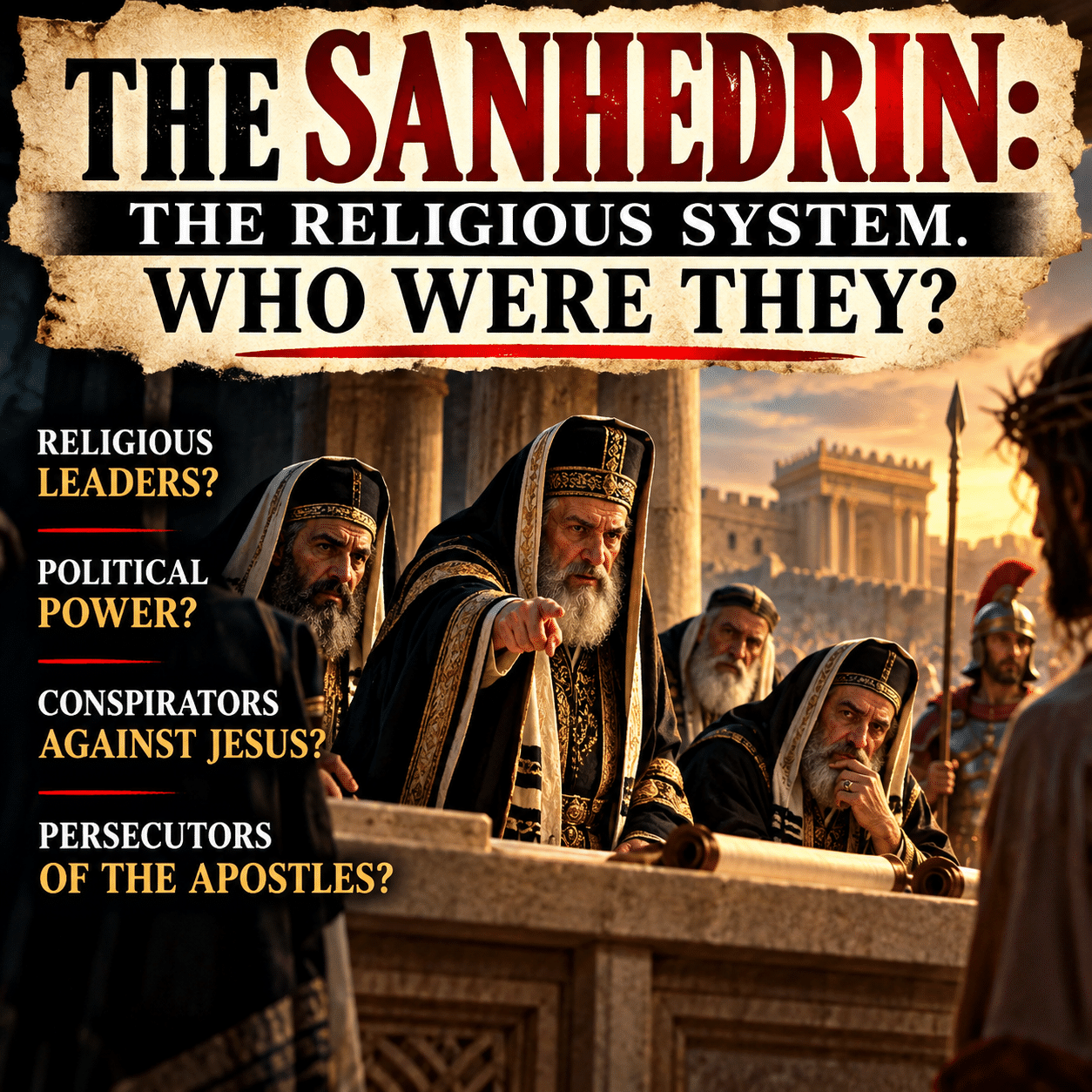
The chief priests, scribes, Pharisees, and Sanhedrin exercised tremendous influence. Roman governors possessed civil and military power. At times, these authorities cooperated in opposing Jesus and His followers.
Paul had already described rulers belonging to that age.
Howbeit we speak wisdom among them that are perfect: yet not the wisdom of this world, nor of the princes of this world, that come to nought:
1 Corinthians 2:6
Which none of the princes of this world knew: for had they known it, they would not have crucified the Lord of glory.
1 Corinthians 2:8
The word translated world in these verses is aiōn, meaning age.
Paul spoke of rulers of that age whose wisdom was coming to nothing.
And who participated in the crucifixion of Jesus?
The kings of the earth stood up, and the rulers were gathered together against the Lord, and against his Christ.
Acts 4:26
For of a truth against thy holy child Jesus, whom thou hast anointed, both Herod, and Pontius Pilate, with the Gentiles, and the people of Israel, were gathered together,
Acts 4:27
The apostles identified the rulers and authorities who had gathered against Christ.
Religious and political powers worked together in opposing Him.
When Paul later wrote about principalities and powers confronting the church, his readers had every reason to understand the reality of organized opposition from the authorities of their age.
The expression flesh and blood does not require us to conclude that every opposing power must have been a supernatural being. Paul’s point was that their struggle was greater than ordinary personal conflict. They were confronting entrenched powers and the darkness operating through them.
Within the first-century covenantal setting, the Jewish religious leadership was a major part of that opposition, although Roman political authorities also played an important role.
And we should be careful not to overlook something else.
The word Satan itself comes from a term meaning adversary. The Greek word diabolos, translated devil, means slanderer or accuser.
These terms must be examined according to their contexts rather than assuming that every occurrence automatically identifies a fallen angel.
The New Testament gives us numerous examples of human adversaries, accusers, and persecutors opposing the work of Christ.
We do not have to assume an invisible army of fallen beings to recognize the very real opposition the early church was facing.
Paul’s warning becomes especially meaningful when we consider the historical enemies confronting those believers.
WITHSTANDING IN THE EVIL DAY
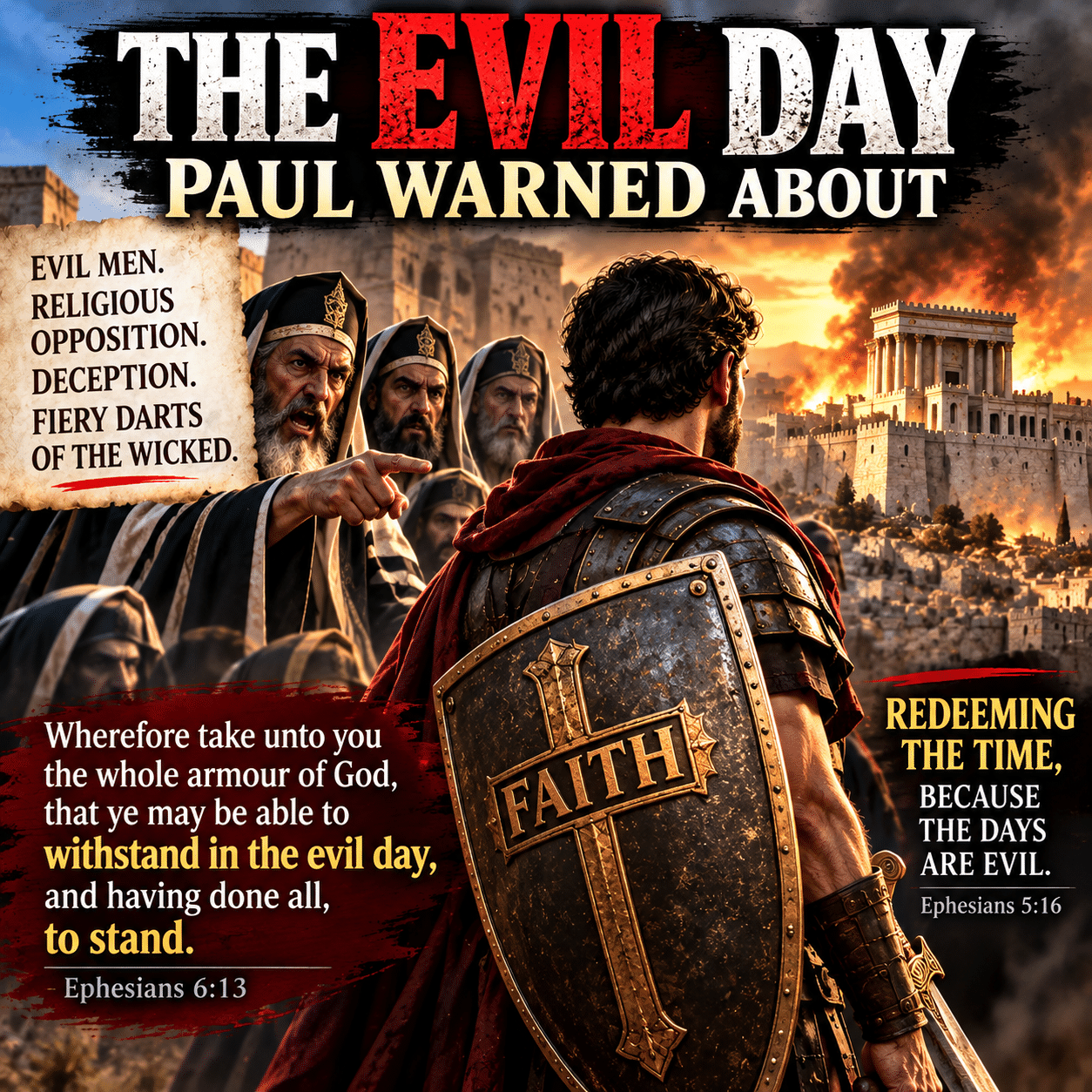
Wherefore take unto you the whole armour of God, that ye may be able to withstand in the evil day, and having done all, to stand.
Ephesians 6:13
Notice what Paul did not say.
He did not tell Christians to overthrow the religious establishment.
He did not command them to fight against Rome.
He did not instruct them to take up physical weapons against their persecutors.
He told them to withstand.
And having done all, to stand.
The evil day was a time requiring endurance, steadfastness, and faithfulness.
And this brings us directly to the prophetic warnings of Jesus.
Then shall they deliver you up to be afflicted, and shall kill you: and ye shall be hated of all nations for my name’s sake.
Matthew 24:9
And then shall many be offended, and shall betray one another, and shall hate one another.
Matthew 24:10
And many false prophets shall rise, and shall deceive many.
Matthew 24:11
And because iniquity shall abound, the love of many shall wax cold.
Matthew 24:12
Jesus described persecution, betrayal, deception, false prophets, and increasing lawlessness.
These were precisely the kinds of conditions the early church experienced.
Then Jesus gave an instruction that closely parallels Paul’s warning.
But he that shall endure unto the end, the same shall be saved.
Matthew 24:13
Endure unto what end?
The end of the age under discussion in Matthew 24.
The disciples had asked Jesus about the end of the aiōn, the age. They were not asking about the destruction of the physical planet.
And Jesus identified the generation that would experience the fulfillment of His prophecy.
Verily I say unto you, This generation shall not pass, till all these things be fulfilled.
Matthew 24:34
The time of trouble Jesus described belonged to that generation.
The connection becomes even clearer when we examine Daniel.
And at that time shall Michael stand up, the great prince which standeth for the children of thy people: and there shall be a time of trouble, such as never was since there was a nation even to that same time: and at that time thy people shall be delivered, every one that shall be found written in the book.
Daniel 12:1
Jesus drew upon this prophetic language when describing the great tribulation.
For then shall be great tribulation, such as was not since the beginning of the world to this time, no, nor ever shall be.
Matthew 24:21
Within the fulfilled understanding of prophecy, Daniel’s time of trouble and Jesus’ great tribulation point to the first-century crisis culminating in Jerusalem’s destruction in AD 70.
The early Christians were living in the generation that would witness the passing of the old covenant order.
And during that period, Jesus told His followers to endure.
Paul told them to stand.
The connection is powerful.
The church was not commissioned to bring judgment upon Jerusalem through violence. Christ had already pronounced that judgment.
Their responsibility was to remain faithful through the evil days surrounding them.
THE FIERY DARTS OF THE WICKED
Above all, taking the shield of faith, wherewith ye shall be able to quench all the fiery darts of the wicked.
Ephesians 6:16
What were these fiery darts?
Many immediately interpret them as attacks from Satan, understood as a fallen supernatural being.
But consider the attacks that were actually being launched against the first-century church.
The apostles were threatened. Believers were imprisoned. False accusations were made. Religious leaders stirred up opposition. Conspiracies were organized to silence those preaching Jesus Christ.
Stephen experienced this opposition firsthand.
Then they suborned men, which said, We have heard him speak blasphemous words against Moses, and against God.
Acts 6:11
And they stirred up the people, and the elders, and the scribes, and came upon him, and caught him, and brought him to the council,
Acts 6:12
False witnesses and religious accusations were used against Stephen.
These were the methods of wicked men opposing the gospel.
Paul’s fiery darts are figurative language, and the Greek expression translated the wicked can also mean the evil one. Therefore, the wording alone does not prove the identity of the attacker.
Nevertheless, the historical accounts show the kinds of attacks the early Christians were experiencing.
The fiery darts can be understood within this setting as accusations, threats, deception, and persecution intended to destroy their confidence in Christ.
And what did Paul tell them to use against these attacks?
The shield of faith.
Not a physical shield.
Not a sword of steel.
Faith.
The purpose was not to retaliate against their persecutors but to remain steadfast in Jesus Christ.
The wicked could threaten their lives, imprison their bodies, and attempt to silence their testimony, but they could not take away the faithfulness of those who continued trusting in Christ.
And that is why the whole armour of God is so important.
THE WHOLE ARMOUR OF GOD POINTS TO JESUS CHRIST
Paul did not provide the early church with instructions for conquering its enemies through force.
He described the spiritual provision believers possessed in Christ.
Stand therefore, having your loins girt about with truth, and having on the breastplate of righteousness;
Ephesians 6:14
Their loins were to be girt about with truth.
And who is the truth?
Jesus saith unto him, I am the way, the truth, and the life: no man cometh unto the Father, but by me.
John 14:6
Truth was found in Christ, not in the deceptive religious schemes opposing His followers.
The breastplate was righteousness.
But their righteousness was not grounded in their ability to keep the old covenant law.
And be found in him, not having mine own righteousness, which is of the law, but that which is through the faith of Christ, the righteousness which is of God by faith:
Philippians 3:9
Their righteousness came through faith in Jesus Christ.
Interestingly, Paul drew upon imagery already found in the Old Testament.
For he put on righteousness as a breastplate, and an helmet of salvation upon his head; and he put on the garments of vengeance for clothing, and was clad with zeal as a cloke.
Isaiah 59:17
The Lord Himself was described as wearing righteousness and salvation.
Paul was not inventing an entirely new concept. He was drawing upon the imagery of God’s own armour.
And your feet shod with the preparation of the gospel of peace;
Ephesians 6:15
The early church was not commissioned to spread the gospel through warfare.
They were proclaiming peace through Jesus Christ.
For he is our peace, who hath made both one, and hath broken down the middle wall of partition between us;
Ephesians 2:14
Christ had brought believing Jews and Gentiles together into one new covenant people.
Their message was reconciliation, not retaliation.
And take the helmet of salvation, and the sword of the Spirit, which is the word of God:
Ephesians 6:17
Salvation was found in Jesus Christ.
The sword was the word of God.
Their weapons were not the weapons of political rebellion.
Truth, righteousness, peace, faith, salvation, and the word of God were the means by which believers were to remain steadfast.
And Paul added one more essential instruction.
Praying always with all prayer and supplication in the Spirit, and watching thereunto with all perseverance and supplication for all saints;
Ephesians 6:18
Prayer and perseverance accompanied the armour.
Every part of Paul’s instruction directed the church toward dependence upon God rather than physical resistance against its enemies.
THE NIGHT WAS FAR SPENT
There is another passage that brings the entire study together.
And that, knowing the time, that now it is high time to awake out of sleep: for now is our salvation nearer than when we believed.
Romans 13:11
Paul emphasized the time in which his readers were living.
He told them salvation was nearer than when they first believed.
Within the fulfilled understanding, this points toward the approaching consummation of the covenantal transition inaugurated through Christ.
Then Paul continued.
The night is far spent, the day is at hand: let us therefore cast off the works of darkness, and let us put on the armour of light.
Romans 13:12
Notice the language.
The night was far spent.
The day was at hand.
And believers were instructed to put on the armour of light.
This closely resembles Paul’s instructions in Ephesians.
The Christians were living during evil days, but those days were not without an appointed conclusion.
The old covenant order was approaching its end.
The kingdom of Jesus Christ was not approaching destruction. It was being established as the enduring reality of the new covenant.
The church was to redeem the time, remain faithful, and stand through the coming trouble.
HAVING DONE ALL, TO STAND
When we read Ephesians 6 within its historical setting, Paul’s instructions become much clearer.
The evil day was not introduced as a distant prediction about an unknown generation thousands of years later.
Paul was writing to Christians who were already experiencing the hostility of their age.
They faced evil men, religious deception, political pressure, imprisonment, false accusations, and persecution.
The same authorities who had opposed Jesus continued to resist the proclamation of His gospel.
And the judgment Jesus had foretold upon Jerusalem was drawing near.
The old covenant age was passing away.
But the church was not commanded to bring about its destruction.
The believers were commanded to stand.
Jesus had told His disciples to endure unto the end.
Paul told the Ephesians to withstand in the evil day.
And both instructions find their significance within the first-century period of tribulation and covenantal transition.
This does not mean Christians in later generations never experience evil, persecution, or deception. Nor does it mean the truth, righteousness, faith, and salvation described by Paul have ceased to matter.
The spiritual principles remain valuable for every believer.
But their continuing value does not require us to remove Paul’s warning from its original historical setting.
The first-century church was called to remain faithful during a time of trouble unlike anything Israel had previously experienced.
And when that age reached its appointed end, Jesus Christ remained victorious.
The temple fell, but Christ remained.
The sacrifices ceased, but Christ remained.
The earthly priesthood lost its temple, but Christ remained the great High Priest of the new covenant.
The old covenant order passed away, but the kingdom of Jesus Christ remained.
The evil day was not a call for Christians to fight an invisible army of fallen angels. Or modern world powers. It was a call for the early church to stand faithfully in Christ while the powers opposing His gospel were brought to nothing.
The whole armour of God was never about making believers powerful enough to defeat their enemies through human strength.
It was about remaining established in the One who had already overcome.
Paul told them to redeem the time because the days were evil. Jesus told them to endure unto the end. And when the evil day came, their calling was not to fight, but having done all, to stand.