Table of Contents
MY PERSONAL JOURNEY THROUGH THEOLOGY, COGNITIVE DISSONANCE AND PASTORAL MINISTRY
Have you ever believed something so strongly, so passionately, and for so long that you couldn’t imagine being wrong about it?
I have!
And let me tell you, when those long-held beliefs begin to unravel, it can shake you to your very core!
I’m not talking about changing your mind over some insignificant disagreement. I’m talking about deeply rooted theological convictions. Things you’ve heard preached from the pulpit, studied in Sunday school, accepted from respected ministers, and perhaps even preached yourself!
Then one day, you begin examining the Scriptures a little more closely. You start asking questions. You notice things you’ve overlooked for years. Passages you thought you understood suddenly take on an entirely different meaning when examined within their historical, cultural, and covenantal context.
And before you know it, you’re questioning something you once considered unquestionable!
Welcome to the uncomfortable world of cognitive dissonance!
WHEN THEOLOGY BEGINS TO SHAKE
Cognitive dissonance is the mental and emotional discomfort we experience when new information challenges our existing beliefs.
And believe me, when it comes to theology, that discomfort can be intense!
Our beliefs aren’t developed in a vacuum. They’re influenced by our upbringing, religious traditions, respected teachers, personal experiences, and the churches we’ve attended.
Sometimes we’ve held those beliefs for so long that we no longer distinguish between what Scripture actually says and what we’ve always been told Scripture means.
There’s a world of difference between the two!
I’ve experienced that uncomfortable struggle personally. There have been times when my theological understanding was turned upside down. I’ve had to go back to the drawing board, roll up my sleeves, and examine passages I thought I had settled long ago.
Some questions were answered relatively quickly. Others took years of serious, sometimes frustrating study.
And yes, I’m still learning!
There are biblical subjects I’m continuing to investigate, questions I’m still wrestling with, and passages I’m still working to understand more thoroughly.
I’m not ashamed to admit that.
Being confident in what you believe doesn’t mean pretending you have all the answers.
In fact, I believe one of the greatest obstacles to spiritual growth is reaching the point where we think there’s nothing left to learn.
BUILDING A FOUNDATION BEFORE INTRODUCING THE CHALLENGE
Over the years, I’ve developed a particular approach to teaching, especially when dealing with challenging theological subjects.
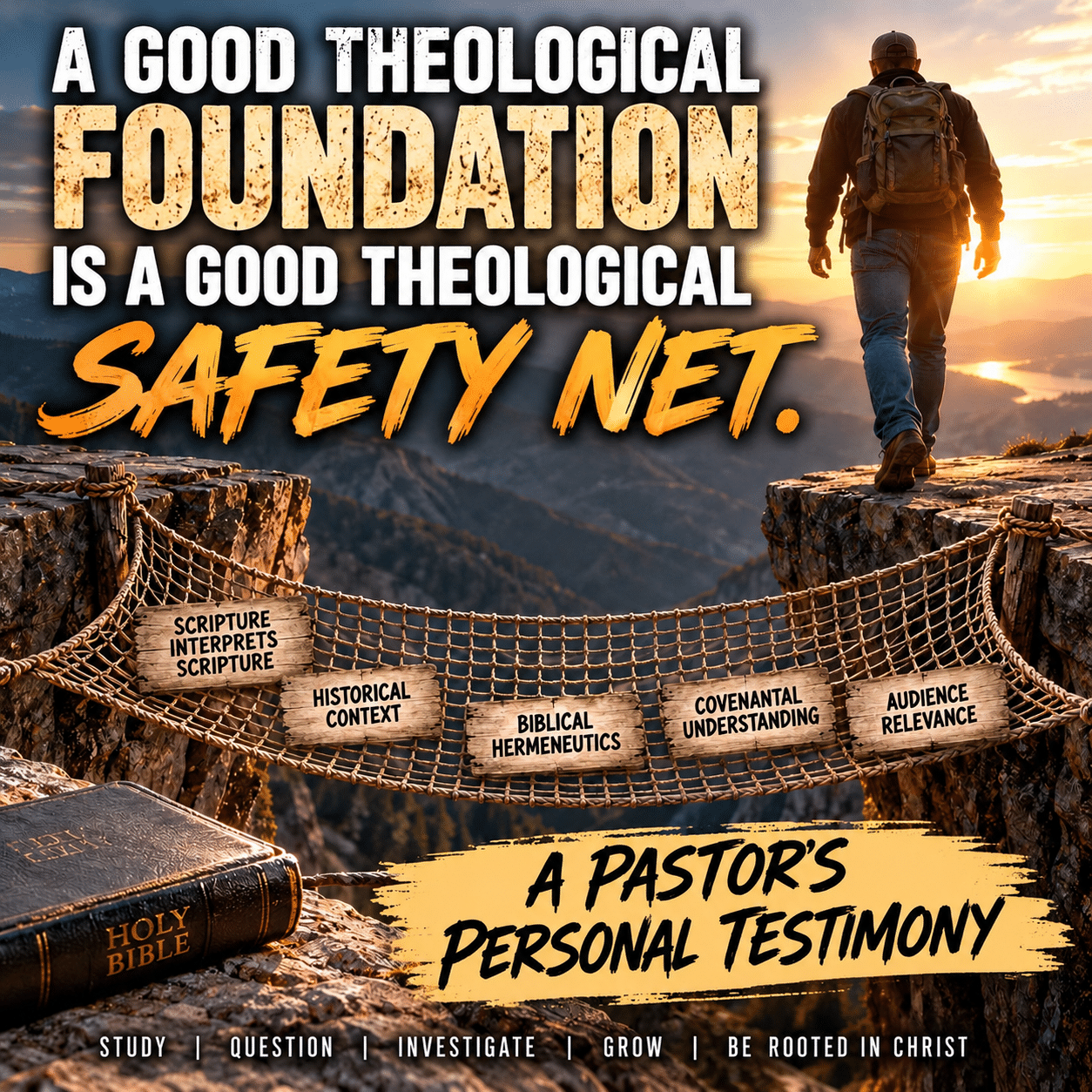
I believe a good theological foundation is a good theological safety net.
Let me explain what I mean.
Suppose someone has held a particular theological belief for most of their life. Then, out of the blue, a minister introduces a teaching that directly contradicts everything they’ve been taught.
What happens?
For some, the walls immediately go up!
They’re shocked, confused, defensive, or even offended. They may reject the teaching before they’ve had an opportunity to examine the Scriptures supporting it.
But what if that minister had spent considerable time laying a strong biblical foundation?
What if, rather than immediately introducing the most controversial conclusion, he began teaching the foundational truths that lead toward it?
In my own ministry, particularly concerning eschatology, I’ve found this approach extremely valuable.
I spend time establishing biblical hermeneutics, audience relevance, historical context, covenantal understanding, and the importance of allowing Scripture to interpret Scripture.
These aren’t unrelated subjects thrown together to soften the blow of some future teaching. They’re essential parts of the very biblical framework we’re studying. The laws and principles of interpretation.
Little by little, piece by piece, the foundation begins to take shape.
And something fascinating can happen along the way.
Some people begin connecting the dots for themselves!
They recognize where the Scriptures are leading before I ever introduce the more challenging conclusion.
Others may be surprised when I finally bring it out, but because they’ve already examined the foundational passages, the teaching doesn’t seem nearly as foreign or unsettling.
There may still be questions. There may still be little to some cognitive dissonance. But instead of watching their entire theological framework come crashing down, they’re able to examine the subject with greater understanding and confidence.
Sometimes the foundation doesn’t merely cushion the fall. It prevents the crash altogether!
And that’s the beauty of patiently building a sound biblical foundation.
YOU DON’T HAVE TO AGREE WITH ME!
Now, here’s something I feel very strongly about.
I’ve told the congregation I pastor on numerous occasions:
“You don’t have to agree with me. You have the freedom to believe differently. But I want you to consider what the Scriptures are saying.”
And I mean every word of that!
I’m not interested in creating a congregation that simply echoes everything their pastor believes.
What would that accomplish?
If someone believes a particular doctrine merely because I preached it, have I really taught that person how to study Scripture? Or have I simply convinced them to exchange someone else’s interpretation for mine?
I want people to THINK!
I want them to question, investigate, compare passages, examine context, even shoot holes in it, and develop convictions grounded in Scripture rather than personalities or traditions.
And yes, that includes examining what I preach!
Consider the Bereans.
These were more noble than those in Thessalonica, in that they received the word with all readiness of mind, and searched the scriptures daily, whether those things were so.
Acts 17:11
Think about that!
They examined what the apostle Paul was teaching!
If Paul’s teaching was examined against the Scriptures, why should any pastor expect his congregation to accept everything he says without examination?
I certainly don’t!
In my earlier years I was in a church culture where questioning or even respectfully and openly disagreeing with a pastor was prohibited. It was an unsaid rule but still cultural. You conformed to his teachings.
So, here’s another important reason I give people the freedom to disagree.
It allows them to process difficult theological questions at their own pace.
Some people grasp a particular subject quickly. Others need time to study, reflect, ask questions, and wrestle with what they’re discovering.
Some may take months. Others may take years.
And some may never reach the same conclusion I have.
That’s okay! They are still loved! I believe love comes before doctrine.
My responsibility is to faithfully teach the Scriptures, not control the timetable of someone else’s understanding.
I’ve learned that genuine conviction cannot be forced, hurried, or manufactured through pressure.
I would much rather someone disagree with me after sincerely examining Scripture than agree with me simply because I’m their pastor.
SOMETIMES HARD KNOCKS MAKE BETTER TEACHERS
My approach to pastoral ministry didn’t develop overnight.
Life has a way of teaching us lessons that no classroom, theological textbook, or ministerial seminar can fully prepare us for.
I’ve experienced opposition. I’ve had deeply held convictions challenged. I’ve encountered situations that were painful, disappointing, and difficult to understand.
And those experiences have helped shape the pastor I am today.
Here’s something I’ve learned along the way.
Sometimes we’re so busy looking for examples of what TO DO in ministry that we overlook the valuable lessons we learn from discovering what NOT TO DO!
Believe me, those lessons can be just as important!
I’ve never believed that humility requires a pastor to be timid, spineless, or afraid to stand for his convictions.
I’m passionate about what I believe. When I’m convinced that Scripture teaches something, I’m not going to abandon it because it may be unpopular, controversial, or misunderstood.
I’ve never been particularly intimidated by labels or crowds.
But I’ve also learned that being bold doesn’t give me permission to be harsh, arrogant, or insensitive toward people who disagree.
There’s a difference between standing firmly on your convictions and demanding that everyone else immediately embrace them.
You can have a steel spine without having an iron fist!
And you can speak the truth boldly while still extending patience, kindness, and love.
But speaking the truth in love, may grow up into him in all things, which is the head, even Christ:
Ephesians 4:15
That’s the balance I want in my ministry.
EVEN PETER ACKNOWLEDGED THAT SOME THINGS WERE DIFFICULT TO UNDERSTAND
One passage that has become especially meaningful to me in this discussion is found in 2 Peter 3.
Peter was addressing profound eschatological matters, including the day of the Lord and the promise of new heavens and a new earth.
Then he made a remarkable observation concerning Paul’s writings.
As also in all his epistles, speaking in them of these things; in which are some things hard to be understood, which they that are unlearned and unstable wrest, as they do also the other scriptures, unto their own destruction.
2 Peter 3:16
Did you catch that?
Peter acknowledged that some of Paul’s writings were hard to understand!
And he warned about the danger of twisting or mishandling those Scriptures.
That’s worth thinking about.
If some of Paul’s writings were difficult for believers in the first century to understand, why should we imagine that every challenging passage will be immediately understood by believers today?
Why should we expect people to abandon deeply ingrained interpretations after hearing a single sermon?
And why should pastors feel compelled to act as though every difficult biblical question has already been answered?
Peter continued:
Ye therefore, beloved, seeing ye know these things before, beware lest ye also, being led away with the error of the wicked, fall from your own stedfastness.
2 Peter 3:17
But grow in grace, and in the knowledge of our Lord and Saviour Jesus Christ. To him be glory both now and for ever. Amen.
2 Peter 3:18
Notice that final encouragement.
GROW!
Growth is a process.
Understanding develops. Knowledge increases. Questions arise. Assumptions are examined. And sometimes we discover that what we thought was firmly established needs to be reconsidered.
That doesn’t necessarily mean we’re abandoning our faith.
Sometimes it means we’re finally learning to distinguish between our faith in Christ and the theological framework we’ve built around Him.
And those are not always the same thing!
I’M STILL A STUDENT OF THE SCRIPTURES
There’s another side of this journey I want to share openly.
Sometimes I’ve spent years studying a particular subject before introducing it more fully to the congregation.
Even though I may have thought they weren’t ready to hear because it was too deep. On the other hand, maybe I was not ready for the questions they may have presented.
That’s right, sometimes I wasn’t ready!
Not necessarily because I lacked conviction, but because I knew there were difficult passages I still wanted to examine, objections I needed to consider, and questions I wanted to be better prepared to answer. I still have challenging questions even today.
I’ve learned that reaching a theological conclusion and being prepared to teach that conclusion responsibly are not always the same thing.
And let me make something perfectly clear.
That doesn’t mean I’m afraid of controversy!
I’ve encountered enough opposition in my life to know that you cannot build your ministry around trying to please everybody.
If you do, you’ll spend your entire life chasing your tail!
But there’s a tremendous difference between being afraid to teach something and having the wisdom to recognize that a subject deserves further study and thoughtful preparation.
I don’t want to rush ahead simply because I’ve become excited about something I’ve discovered.
And I certainly don’t want to expect others to understand in one afternoon what may have taken me years to work through.
I want to be able to listen to their questions, consider their concerns, and point them back to the Scriptures.
And when I don’t know something, I want to have enough humility to say, “That’s a good question. I need to study that further.” This happens at times and I do.
Even though I’m a teacher and no novice, I’m still a student of the Scriptures, and I intend to remain one.
WHEN THE FOUNDATION IS STRONG, THE JOURNEY BECOMES EASIER
Let me return to where I started.
A good theological foundation is a good theological safety net.
But as I’ve reflected on this principle, I’ve come to realize that the foundation accomplishes something even greater.
It doesn’t simply protect people from the discomfort of theological change.
It prepares them to discover biblical truths for themselves.
When we patiently establish sound hermeneutical principles, examine Scripture in context, and allow Scripture to interpret Scripture, we’re giving people something far more valuable than a collection of theological conclusions.
We’re giving them the tools to study, question, discern, and grow.
And sometimes, long before we introduce a challenging teaching, they’ve already begun recognizing where those foundational truths are leading.
There may be no dramatic theological collapse.
No devastating crisis.
No earth-shattering moment when everything they once believed comes tumbling down.
Instead, there may simply be a gradual, thoughtful, and deeply personal journey toward a clearer understanding of Scripture.
And isn’t that what we should desire?
I don’t want people to be afraid of asking questions.
I don’t want them to feel threatened because something they’ve believed for years is being challenged.
And I certainly don’t want them thinking that disagreeing with their pastor somehow makes them less faithful to Christ.
We are all working from a different theological grid.
My goal isn’t to win a theological popularity contest, collect followers of my personal interpretations, or prove that I’ve got everything figured out.
Far from it!
My desire is to help people develop a strong enough biblical foundation that they’re not afraid to examine what they believe, why they believe it, and whether those beliefs can withstand the careful examination of Scripture.
And that same standard applies to me.
After all, I’m still learning, still growing, and still willing to reconsider my understanding when Scripture gives me reason to do so.
I may be passionate. I may be bold. And when I’m convinced of something, I’m certainly not afraid to stand my ground.
But I never want my convictions to become an excuse for closing my mind to further understanding.
Because at the end of the day, this journey isn’t about defending my theology at all costs.
It’s about being faithful to Christ, handling His Word responsibly, and having the humility to keep learning.
And if I’ve learned anything through the hard knocks, unexpected turns, and sometimes uncomfortable discoveries along the way, it’s this:
A strong foundation doesn’t make us afraid of questions. It gives us the confidence to ask them.
And perhaps one of the greatest things I can give the people I pastor is not simply the freedom to agree with me, but the freedom to disagree, investigate, and grow at their own pace. This is extremely important.
Because ultimately, I don’t want them standing on my convictions.
I want them standing on Christ, with convictions they’ve examined for themselves through the Scriptures.