
Table of Contents
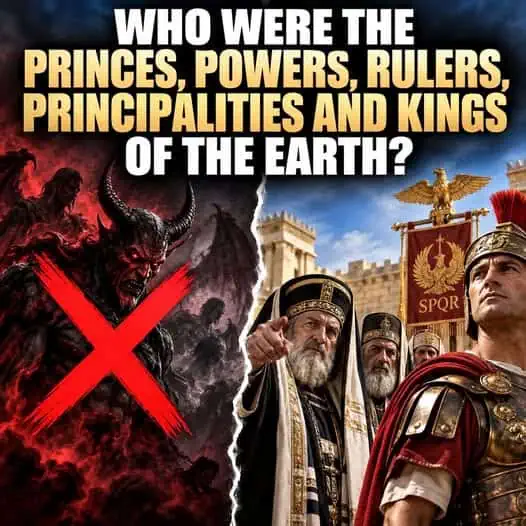
When many read words such as principalities, powers, rulers, and spiritual wickedness, they immediately think of Satan, demons, fallen angels, and invisible supernatural beings. But is that conclusion actually demanded by the text? What happens if we allow Scripture to identify these rulers before assigning an identity to them?
Paul gives us an excellent place to begin.
Howbeit we speak wisdom among them that are perfect: yet not the wisdom of this world, nor of the princes of this world, that come to nought: 1 Corinthians 2:6
Which none of the princes of this world knew: for had they known it, they would not have crucified the Lord of glory. 1 Corinthians 2:8
The word translated “princes” is the Greek word archōn. It means a ruler, leader, chief, or one exercising authority. Many modern translations therefore say “rulers of this age.” Nothing in the word itself requires us to understand these princes as demonic beings. Paul says these rulers did not understand God’s wisdom, and had they understood it, they would not have crucified the Lord of glory.
That raises an important question: Who does Scripture identify as the rulers involved in the crucifixion of Jesus?
SCRIPTURE IDENTIFIES THE RULERS
Acts gives us a remarkably clear answer by applying Psalm 2 directly to the events surrounding the crucifixion.
The kings of the earth stood up, and the rulers were gathered together against the Lord, and against his Christ. Acts 4:26
Luke then tells us who those kings and rulers were. This also resembles the kings of the earth in the book of Revelation.
For of a truth against thy holy child Jesus, whom thou hast anointed, both Herod, and Pontius Pilate, with the Gentiles, and the people of Israel, were gathered together, Acts 4:27
Notice that Scripture does not identify these rulers as fallen spiritual beings. It identifies Herod, Pontius Pilate, the Gentiles, and the people of Israel. These were real first-century rulers and authorities who gathered together against Christ. Peter had already said something similar on the Day of Pentecost.
This is monumental.
Him, being delivered by the determinate counsel and foreknowledge of God, ye have taken, and by wicked hands have crucified and slain: Acts 2:23
Of course, Rome physically carried out the crucifixion, but the Jewish leadership were the vehicle that delivered Jesus over to Roman authority. Yes, both were involved. The book of Acts repeatedly shows the apostles facing opposition from rulers, elders, chief priests, councils, governors, and other authorities.
This gives us important background for understanding Paul’s repeated language concerning principalities and powers.
CHRIST TRIUMPHED OVER PRINCIPALITIES AND POWERS
Paul uses very similar terminology in Colossians.
And having spoiled principalities and powers, he made a shew of them openly, triumphing over them in it. Colossians 2:15
The words translated “principalities and powers” are archē and exousia, words associated with rule and authority. Again, the words themselves do not automatically mean fallen angels.
And we shouldn’t pull Colossians 2:15 out of its surrounding covenantal context.
Immediately before this, Paul writes:
Blotting out the handwriting of ordinances that was against us, which was contrary to us, and took it out of the way, nailing it to his cross; Colossians 2:14
Immediately afterward Paul discusses meat, drink, holy days, new moons, sabbaths, ordinances, and the rudiments of the world. Colossians 2 is saturated with language concerning the religious order from which believers were being delivered. Just a note: rudiments, principles and elements are all the same word and all me the same thing. Old covenant structure. 
The authorities believed that by crucifying Christ they were defeating Him. Paul turns the entire picture upside down. The cross through which the rulers attempted to destroy Christ became the very means through which Christ triumphed over the rulers and authorities.
That brings us to Ephesians 6. This is the go-to passage many use to argue that these powers were fallen spiritual beings.
THE RULERS OF THE DARKNESS OF THIS WORLD
For we wrestle not against flesh and blood, but against principalities, against powers, against the rulers of the darkness of this world, against spiritual wickedness in high places. Ephesians 6:12
This verse is commonly interpreted as describing a hierarchy of invisible demonic beings. But notice something important. Paul never actually uses the words demons or fallen angels in the passage.
Once again we encounter the language of principalities, authorities, and rulers.
Some will immediately respond, “But Paul said they were not wrestling against flesh and blood.” That’s true. But that doesn’t automatically mean Paul’s opponents must therefore have been nonhuman beings. The struggle wasn’t merely against individual men as flesh and blood. Paul was as merely saying, our fight is not with our Jewish ancestry or Jewish ethnic race. The battle is the Jewish oppositional hierarchy. 
The believers were continually confronting powers, authorities, religious opposition, and ruling structures that stood against the gospel of Christ. That is exactly what we see throughout Acts.
The apostles were arrested by authorities. They were brought before councils. They were threatened by rulers. Stephen was killed. James was killed. Paul was repeatedly persecuted and many Christians suffer as well. Yes, the early church was continually confronted by powerful opposition from those occupying positions of religious and political authority.
There was certainly spiritual wickedness involved, but spiritual wickedness does not have to mean fallen spiritual beings. Men occupying positions of religious authority can commit profound spiritual wickedness.
WHAT ABOUT “HIGH PLACES?”
This becomes even more interesting because Paul has already used the language of heavenly places earlier in the same letter.
And hath raised us up together, and made us sit together in heavenly places in Christ Jesus: Ephesians 2:6
The Ephesian believers were still physically living on earth. They had not literally traveled into another dimension and sat down somewhere in the sky. Their position in the heavenly places concerned their spiritual standing, authority, and identity in Christ.
Therefore, we should at least question the assumption that “spiritual wickedness in heavenly places” automatically requires invisible fallen beings inhabiting another realm.
There can be righteous authority associated with heavenly things, and there can also be wickedness operating through those claiming spiritual and religious authority.
This becomes particularly meaningful in the first-century setting where the followers of Jesus were being persecuted by men who claimed to represent God while opposing the sent Messiah.
THE ORDER OF THAT AGE WAS PASSING AWAY
Now go back to where we started.
Paul said the rulers of that age were “coming to nought.”
Howbeit we speak wisdom among them that are perfect: yet not the wisdom of this world, nor of the princes of this world, that come to nought: 1 Corinthians 2:6
That language fits beautifully within the New Testament’s transitional setting. An age was passing away. The Old Covenant order was becoming obsolete and ready to disappear. The kingdom of Christ was being established and manifested while the authorities opposing it were losing their covenantal standing and power. Their power structure and echelon was about to plummet down.
Rom 16:20 The God of peace will quickly crush Satan under your feet…
Remember Satan is not a name it is a title meaning adversary.
And Paul gives us another important piece of the picture.
Then cometh the end, when he shall have delivered up the kingdom to God, even the Father; when he shall have put down all rule and all authority and power. 1 Corinthians 15:24
There they are again:
Rule. Authority. Power.
Paul’s expectation was that Christ would put down opposing rule and authority as His kingdom prevailed.
This fits remarkably well with the forty-year transition from the cross to the destruction of Jerusalem in AD 70. Also known as the official “last days.” Christ had been enthroned. The gospel was going throughout the nations. His adversarial enemies were being placed beneath His feet, while the covenantal order that had rejected Him was approaching its judgment.
LET THE CONTEXT IDENTIFY THE POWERS
My point is the occurrences of principalities, powers, or rulers everywhere in Scripture must not be interpreted as a fallen satanic beings. Context matters. We must let scripture interpret the scripture.
But the opposite assumption should also be challenged.
We should not read the words principalities, powers, rulers, or even spiritual wickedness and automatically insert Satan, demons, or fallen angels into the passage when the text has not identified them that way.
The Greek words themselves describe rule, rulers, authority, and powers. And Scripture plainly demonstrates that these words and concepts can describe actual first-century rulers. Acts identifies rulers who gathered against Christ.
First Corinthians speaks of rulers who crucified the Lord of glory and were coming to nothing.
Colossians speaks of Christ triumphing over principalities and powers through the cross.
Ephesians describes the church struggling against principalities, powers, and rulers during the very period when those authorities were fiercely opposing Christ and His people.
And First Corinthians 15 looks toward Christ putting down all rule, authority, and power.
Maybe we have been too quick to populate these passages with invisible beings when the New Testament itself gives us a very visible conflict.
Jesus Christ and His kingdom were confronting the rulers and authorities of an age that was passing away.
This all occurred during the covenantal transition. Not in our future.
And the very cross they used in an attempt to destroy Him became the instrument of their defeat.