
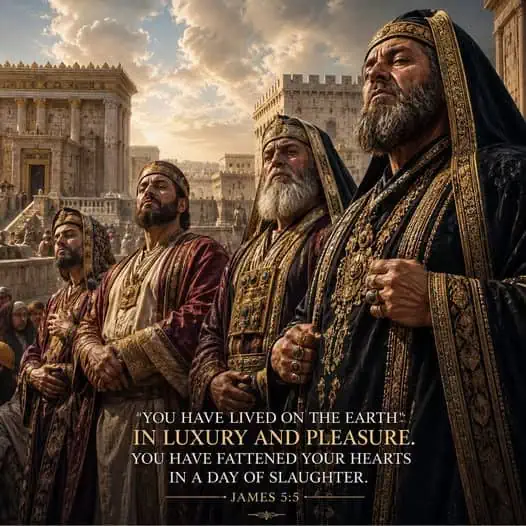
The Rich Men in James 5
Go to now, ye rich men, weep and howl for your miseries that shall come upon you. James 5:1
The Rich Men of James 5 and the Coming Judgment on Jerusalem:
When James rebuked the rich in James 5, he was not simply giving a general warning against wealth or someone rich in our day and time as many assume. He was addressing and confronting the wealthy oppressors who were exploiting the poor, withholding wages, living in luxury, while persecuting the righteous during his time.
James wrote:
“Go to now, ye rich men, weep and howl for your miseries that shall come upon you.” James 5:1
Notice that James speaks of miseries that were soon coming upon them. His warning was directed toward twelve tribes scattered abroad living in his own generation who were heading toward foretold judgment.
He continues:
“Your riches are corrupted, and your garments are motheaten. Your gold and silver are cankered… Ye have heaped treasure together for the last days.” James 5:2–3
As we’ve learned, that phrase, “the last days,” is extremely important. From a fulfilled perspective, James was writing during the last days of the Old Covenant age, leading up to the destruction of Jerusalem and the Temple in their day and time.
These wealthy men trusted in their riches while judgment was closing in around them.
James had already identified the rich as persecutors earlier in the letter:
“Do not rich men oppress you, and draw you before the judgment seats?” James 2:6
Then in James 5 he describes their injustice:
“The hire of the labourers who have reaped down your fields, which is of you kept back by fraud, crieth.”
James 5:4
These were the leaders, powerful men getting rich by taking advantage of common laborers. Yet while they were accumulating wealth, James says they were actually preparing themselves for destruction:
It continues with:
“Ye have lived in pleasure on the earth, and been wanton; ye have nourished your hearts, as in a day of slaughter.” James 5:5
That is strong prophetic language. They were fattening themselves with indulgence for the very day of judgment that was closing in. They should have known this because their Old Testament scriptures had repeatedly warned them of this time.
James then adds:
“Ye have condemned and killed the just, and he doth not resist you.” James 5:6
This fits remarkably well with what Jesus had already said concerning the religious leadership of Jerusalem in His day.
Jesus accused the scribes and Pharisees of devouring widows’ houses, persecuting the righteous, and filling up the measure of their fathers, or in other words, finishing what their fathers started. He then declared that all the righteous blood would be required of “this generation” Matthew 23:32–36.
Immediately afterward, Jesus walked out of the Temple and announced that it would be destroyed:
As we’ve discussed, “There shall not be left here one stone upon another, that shall not be thrown down.” Matthew 24:2
Take note of this next thought:
The Temple itself was not merely a religious building where priestly duties were performed. It was also deeply connected to the economic life of Jerusalem. Large amounts of money flowed through the Temple system. The Temple contained treasuries, received taxes and offerings, and held enormous quantities of gold, silver, garments, and other valuables of the rich.
The Temple functioned as a major financial center and complete storehouse of wealth.
Historian Josephus records that when Jerusalem fell in his generation, the Romans seized and destroyed immense amounts of wealth associated with the Temple. Gold, silver, sacred vessels, garments, and treasure were carried away. Remember, these plundered valuables were later used to build the future Colosseum in Rome in 72 CE.
The very system in which many had placed their confidence collapsed. Sadly, because of their wealth, they did not take heed of the words of Jesus and the apostles to flee the city when they clearly saw the signs. They stayed with their riches and suffered peril when Rome invaded their city.
That makes James’ words especially powerful:
“Ye have heaped treasure together for the last days.”
The last days of the old Mosaic covenant not the last days of the global world.
They believed they were securing themselves through their riches, but James warned that their riches would not save them from the judgment that was soon approaching.
And then James turns to the persecuted believers:
“Be patient therefore, brethren, unto the coming of the Lord.” James 5:7
He continues:
“The coming of the Lord draweth nigh.” James 5:8
And then:
“Behold, the judge standeth before the door.” James 5:9
James was comforting believers who were suffering under powerful oppressors. He was telling them that their vindication was near, and it was.
The rich persecutors appeared powerful. They controlled land, money, courts, and religious influence. But their entire world was about to collapse.
They were storing up gold, but James said they were actually storing up judgment.
They trusted in their riches while James told the believers to trust in the Lord.
And within that generation, Jerusalem fell, the Temple burned, its treasures were plundered, and the system that had persecuted the followers of Christ came crashing down.
James 5 therefore reads much like the prophets of old and much like Jesus in Matthew 23 & 24. The covenant oppression had reached its fullness, the cries of the righteous had reached the ears of the Lord, and judgment was standing at the door.
Very importantly, the day of the Lord is always connected with the destruction of Jerusalem and the removal of the old Mosaic economy.
This is definitely not in our future. This was absolutely for their future.